By the Artixium technical team · Updated 14 October 2026
The history of LED technology really begins in 1962, when Nick Holonyak Jr. demonstrated the first visible-light emitting diode at General Electric: a red LED. Yet it took more than thirty years to obtain a blue and a green bright enough to complete the palette, the two colours a full-colour LED screen could not do without. This guide walks through the key milestones, the pioneers behind them, and what they mean in practice when you choose a large LED display today.
Who invented the LED?
There is no single inventor, but a chain of discoveries:
- 1907: Henry Joseph Round, an engineer at Marconi, is the first to report light emitted by a silicon carbide crystal carrying a current. The phenomenon is called electroluminescence.
- 1927: Russian physicist Oleg Losev publishes the first detailed studies of the effect.
- 1955: Rubin Braunstein, at RCA, reports infrared emission from several semiconductors, including gallium arsenide.
- 1962: Nick Holonyak Jr., at General Electric, builds the first LED in the visible spectrum, made of gallium arsenide phosphide. It glows red. He is often called the father of the LED.
What are the key dates in the history of LED?
- 1962: first visible LED, red (Holonyak, General Electric).
- 1960s and 1970s: red, orange, amber and yellowish-green LEDs become common as indicator lights and in the first numeric displays.
- 1972: George Craford, at Monsanto, creates the first yellow LED and much brighter red and orange LEDs.
- 1989: Cree commercialises a silicon carbide blue LED, still very faint. The same year, Isamu Akasaki and Hiroshi Amano obtain p-type gallium nitride.
- 1993: Nichia launches the high-brightness blue LED developed by Shuji Nakamura.
- 1995: Nichia introduces a pure-green LED. With red and blue, the RGB trio is complete.
- 1996: first commercial white LED, a blue LED coated with a yellow phosphor.
- 2014: Akasaki, Amano and Nakamura share the Nobel Prize in Physics for the blue LED.
Why did the blue LED take thirty years?
After red, the colours moved on to orange and yellowish-green. Blue held out. In 1989 Cree did bring a silicon carbide blue LED to market, but the material is a poor light emitter: its bandgap is indirect, so most of the energy is lost as heat. Blue existed, but it was far too dim for a screen.
Research teams followed two routes. Most favoured zinc selenide, which could be grown with relatively few crystal defects. Gallium nitride (GaN) looked better on paper, but two problems stood in the way: growing good-quality crystals, and making the p-type layer every diode needs.
In Japan, Isamu Akasaki and Hiroshi Amano cleared the first hurdle: in 1989 their team activated p-type GaN using electron-beam irradiation. At Nichia, Shuji Nakamura took the route many considered a dead end. He modified his own crystal-growth equipment and developed thermal annealing, a simpler and faster activation method suited to production. Indium gallium nitride (InGaN) became the light-emitting heart of his bright blue LEDs, which Nichia released in 1993.
All three researchers shared the 2014 Nobel Prize in Physics, awarded for the invention of efficient blue LEDs.
How did pure green complete the RGB trio in 1995?
An LED screen builds every pixel from three LEDs: one red, one green and one blue. By adjusting their intensity, it can produce any colour, all the way to white. This is additive colour mixing.
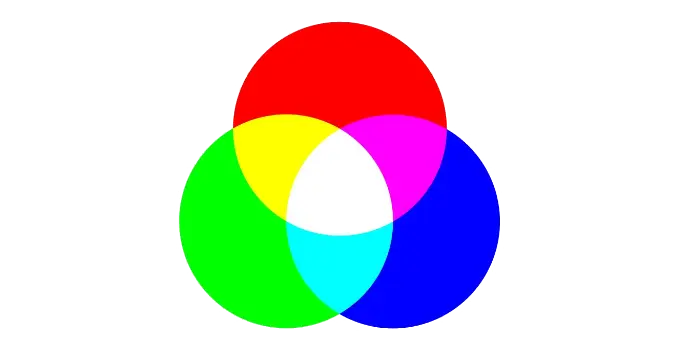
Until 1995, a true green was missing. The yellowish-green LEDs of older equipment could not reproduce colours faithfully. Nichia’s pure-green LED, made of InGaN like the blue, changed that: together with red and blue, it made the first bright, full-colour video LED screens possible. Everything that followed in the history of LED displays stems from that moment.
It is also where the idea of pixel pitch comes from: the distance between two RGB pixels, which sets the ideal viewing distance. Our fine pitch displays such as Granite and Qwartz 3 go below 2 mm between pixels.
Why did LED screens come before LED lighting?
In 1996, Nichia commercialised the first white LED: a blue LED coated with a yellow phosphor that converts part of the blue light into longer wavelengths. The eye sees the mix as white. The door to LED lighting was open.
Producing white light and replacing a cheap light bulb are two very different things, though. In the early days, manufacturing yields were low: few usable chips per wafer meant a high cost per LED, and brightness and colour varied from one chip to the next. A household lamp could not absorb that cost against a bulb that cost next to nothing.
A large LED display could. Its commercial value justified the investment, so displays became the first big market for bright LEDs, before gains in yield, performance and cost made LED lighting viable. Chip-to-chip variation is also why LED screen calibration remains an essential step today.
The bet paid off. According to the Nobel Prize in Physics press release of 7 October 2014, the best white LEDs already exceeded 300 lumens per watt, compared with about 16 for an incandescent bulb and close to 70 for a fluorescent lamp, with a lifetime of up to 100,000 hours. Lighting accounts for about a quarter of the world’s electricity consumption.
How did large LED screens evolve from DIP to COB?
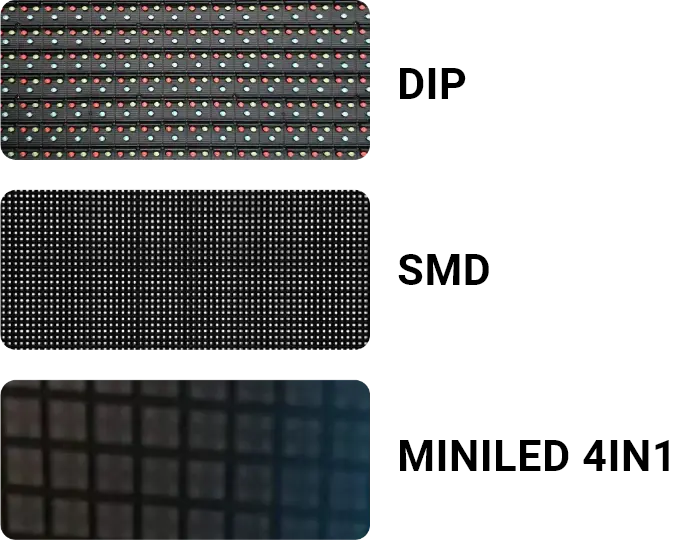
Once the RGB trio was available, LED module technology went through three main generations:
- DIP: three separate through-hole LEDs, one per colour. Very bright and rugged, they equipped the first outdoor screens, but with a wide pixel pitch.
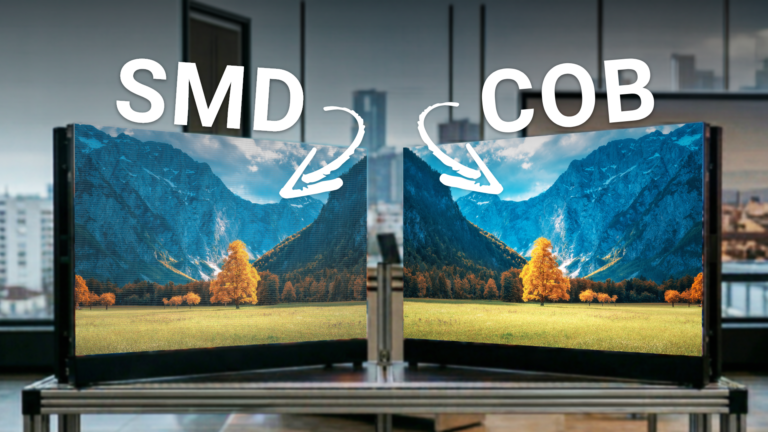
- SMD: the red, green and blue chips sit in a single surface-mounted package. Pixel pitch tightens and viewing angles widen. It is the most widespread technology today, on rental and event LED screens such as Beryl as well as on outdoor LED displays.
- COB, MiniLED and MicroLED: the chips are mounted directly on the board, then encapsulated, or grouped four pixels to a package in 4-in-1 MiniLED modules. Pixel pitch drops below one millimetre, for control rooms, studios and boardrooms. Our Titanite 3 is one example, and our guide What is COB technology? explains its benefits.
What does the history of LED mean for your screen project?
Sixty years of research go into every LED panel. For a buyer, three legacies matter:
- Brightness. InGaN LEDs make screens readable in full sunlight. That is what makes outdoor digital LED billboards and stadium LED displays possible, such as our Neipatec ST perimeter LED system.
- Resolution. Ever-smaller chips allow LED video walls that stay sharp at less than a metre, from Cadmium (from P0.6) to control room LED video walls.
- Colour. Pure blue and green give a palette wide enough for video, broadcast and virtual production, with screens like Beryl XR.
To compare technologies in real conditions, come and see our screens in our showroom, read our guide on refresh rate, or tell our team about your project.
Frequently asked questions about the history of LED
Who invented the LED?
Nick Holonyak Jr. built the first visible-light LED, a red one, at General Electric in 1962. He built on earlier work: Henry Joseph Round observed electroluminescence in 1907, Oleg Losev studied it in 1927, and Rubin Braunstein reported infrared emission from semiconductors in 1955.
Who invented the blue LED?
Shuji Nakamura developed the high-brightness blue LED at Nichia, released in 1993. His work built on advances in gallium nitride by Isamu Akasaki and Hiroshi Amano. All three shared the 2014 Nobel Prize in Physics.
Why was the blue LED so important?
Blue was the missing colour. With red and green, it completes the RGB trio needed for full-colour LED screens, and combined with a phosphor it produces white light for LED lighting.
When did full-colour LED screens appear?
Bright, full-colour LED video screens became possible in the mid-1990s, once the high-brightness blue LED (1993) and the pure-green LED (1995) were available.
What is the difference between DIP, SMD and COB LEDs?
DIP uses three separate LEDs per pixel, bright but with a wide pixel pitch. SMD groups the red, green and blue chips in one surface-mounted package. COB mounts the chips directly on the board and encapsulates them, allowing very fine pixel pitches and a tougher surface.
What sources is this guide based on?
This guide draws on the article by Clifford Rickman, an LED display and lighting engineer specialising in PCB, thermal and structural design: From a faint red glow to full colour: the LED pioneers who changed our world, published on LinkedIn in October 2026. His insider view, especially on the role of manufacturing yield, sheds light on a chapter of the history of LED that is often overlooked. Our thanks to him.
- Clifford Rickman, From a faint red glow to full colour: the LED pioneers who changed our world, LinkedIn, 12 October 2026.
- Nobel Foundation, 2014 Nobel Prize in Physics press release, 7 October 2014.