
By the Artixium technical team · Updated 14 October 2026
A flip chip LED is an LED whose semiconductor die is mounted upside down and connected to the board through tiny solder bumps underneath it, instead of through fine gold or copper bond wires. Removing the wire looks like a small change, yet it improves light distribution, heat dissipation and long-term reliability. That is why flip chip is set to become the reference technology for outdoor LED displays, which work hard, in the sun, all year round. This guide explains how it works, what it changes and what to ask before choosing your screen.
What is a flip chip LED?
For decades, the LED display industry has relied on wire bonding. The LED die sits face up on its package, and tiny gold or copper wires connect its electrodes to the package leads. It is a proven technology that built the modern LED display industry, from the very first red LEDs told in our history of LED guide to today’s screens.
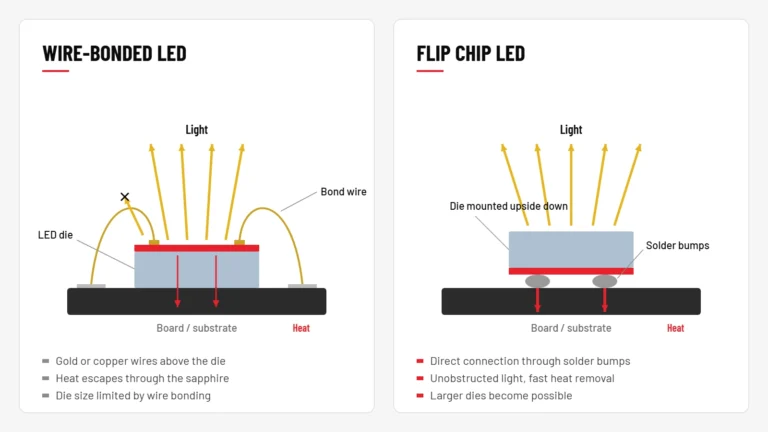
In a flip chip LED, the die is turned over. Its electrical contacts face down and are soldered directly to the substrate through solder bumps. There is no wire above the chip any more: light leaves from the top, heat leaves from the bottom.
What are the differences between flip chip LED and wire bonding?
- Connection. Wire bonding uses one or more fine wires per die. Flip chip uses solder bumps directly under the die.
- Emitting surface. With wire bonding, the wire and its bonding pad sit above part of the light-emitting surface. With flip chip, the surface is clear.
- Heat path. In a wire-bonded die, heat must cross the growth substrate before reaching the board. In a flip chip die, it flows straight through the bumps into the board.
- Weak points. Bond wires are delicate parts that can suffer from thermal cycling and vibration. Flip chip removes them.
- Die size. High-speed wire-bonding equipment favours small dies. Flip chip frees manufacturers from that constraint.
Why is a flip chip LED’s light more even?
In a conventional wire-bonded LED, the bond wire sits above part of the emitting surface. Tiny as it is, it creates a slight optical obstruction, which can cause small variations in brightness, colour distribution and viewing angle.
With a flip chip LED, nothing stands above the emitting surface. Light leaves the semiconductor unobstructed, giving a more symmetrical light distribution and more consistent colour across the whole viewing cone. On fine pitch and premium outdoor screens, where image quality is everything, every gain counts, alongside the black level covered in our guide to LED screen contrast and regular LED screen calibration.
Why does a flip chip LED run cooler?
The biggest advantage of flip chip may well be heat. Because the die is mounted directly on the substrate, heat has a much shorter path to escape. A lower junction temperature brings:
- higher luminous efficiency;
- lower power consumption;
- less colour shift over time;
- greater reliability;
- a longer operating life.
Heat is one of the main causes of LED ageing. Outdoor screens are the most exposed: they run at high brightness to stay readable in daylight, often under direct sun. This is the case for façade and DOOH displays such as Thorite 3 and Cobalt, digital LED billboards and stadium LED displays.
Why is flip chip more reliable outdoors?
An outdoor screen goes through daily temperature swings, cold nights, hot afternoons, humidity and sometimes vibration. These repeated cycles put stress on every interconnection. Bond wires, a few tens of microns thick, are among the most delicate parts of an LED package. By removing them, flip chip eliminates a potential failure point inside each LED.
Reliability still depends on the whole screen: the protection rating explained in our guide to IP ratings, thermal design of the cabinet, power supplies and maintenance. For mobile screens exposed to vibration, such as the LED Trailer, or public space and transport displays that run around the clock, every weak point removed matters. And when a module does need attention, our LED screen repair service takes over.
Why would larger LED dies change everything?
According to Clifford Rickman, this is where the biggest progress is still to come. For decades, LED manufacturers have invested heavily in high-speed wire-bonding machines. Those machines naturally favour fairly small dies, because every die needs a precise wire attachment.
Once the industry fully adopts flip chip production, that limit largely disappears. He expects much larger dies, perhaps in the region of 300 to 400 µm, to become commercially viable for outdoor displays. A larger die offers:
- more light from each LED;
- lower current density;
- higher electrical efficiency;
- less heat;
- greater reliability;
- a longer operating life.
Instead of driving a small die hard to reach the required brightness, a larger die produces the same light under far less electrical and thermal stress. Both manufacturers and end users benefit: lower energy consumption and longer-lasting screens.
Does flip chip also apply to COB and MicroLED?
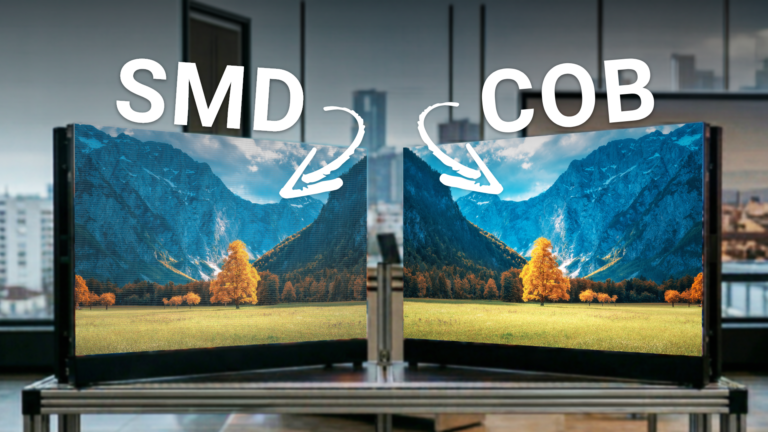
Flip chip is not limited to outdoor displays. Because it needs no space for wires above the die, it is also well suited to very fine pixel pitches. Many recent COB (chip-on-board) and MicroLED displays use flip chip dies mounted directly on the board, then encapsulated. Read our guide What is COB technology?, and discover our ultra fine pitch displays Titanite 3 and Cadmium.
What should you ask before choosing an outdoor LED screen?
Datasheets rarely mention the chip technology. Before choosing an outdoor screen, ask your supplier:
- whether the LEDs are flip chip or wire-bonded;
- how much brightness headroom the screen has, so the LEDs are not always driven at maximum;
- how the cabinet removes heat, and at what ambient temperature the screen is rated;
- how brightness and colour are expected to change over time, and how calibration is handled;
- what warranty and after-sales support are provided.
For fine pitch outdoor projects, such as Silicium (P1.9 – P2.9), or for stadiums with the Neipatec ST perimeter LED system, our team can advise you on the right technology. Come and see our screens in our showroom or tell us about your project.
Frequently asked questions about flip chip LEDs
What is a flip chip LED?
A flip chip LED is an LED whose die is mounted upside down and connected to the board through solder bumps underneath, with no bond wire. Light leaves from the top of the die and heat flows straight into the board.
What is the difference between flip chip and wire bonding?
Wire bonding connects a face-up die with fine gold or copper wires. Flip chip connects an upside-down die directly through solder bumps. Flip chip leaves the emitting surface clear, shortens the heat path and removes the wires, a delicate part.
Do flip chip LEDs use less energy?
They run cooler, and a cooler LED is more efficient, so it needs less power for the same light. Larger flip chip dies, driven at a lower current density, could improve efficiency further.
Is flip chip only for outdoor screens?
No. It suits outdoor screens especially well because of heat and reliability, but it is also widely used in fine pitch indoor displays, including many COB and MicroLED screens.
Do flip chip LEDs last longer?
Less heat and no bond wires both favour a longer life. Actual lifetime still depends on the whole screen: thermal design, power supplies, protection rating and operating brightness.
What sources is this guide based on?
This guide draws on the article by Clifford Rickman, an LED display and lighting engineer specialising in PCB, thermal and structural design: Why Flip-Chip LEDs Are the Future of Outdoor LED Displays, published on LinkedIn in July 2026. His key point: removing the bond wire is not the real breakthrough, freeing die size is. Our thanks to him. Read his other insights in our guides on LED screen contrast and the history of LED.
- Clifford Rickman, Why Flip-Chip LEDs Are the Future of Outdoor LED Displays, LinkedIn, 3 July 2026.