By the Artixium technical team · Updated 14 October 2026
LED display EMC (electromagnetic compatibility) measures how much electromagnetic interference a screen emits, and whether it can disturb the devices around it: radio, television, Wi-Fi and other electronic equipment. Standards define two levels: Class A for commercial and industrial environments, and the stricter Class B for residential environments. With fine pitch LED now entering meeting rooms, studios, private cinemas and living rooms, the class of the screen is no longer a detail. This guide explains the difference between Class A and Class B, why the test conditions matter as much as the certificate, and what to check before installing a large LED display.
What is LED display EMC?
Every electronic device emits electromagnetic energy. An LED screen contains thousands of LEDs switched at high frequency, driver ICs, receiver cards, power supplies and data cables: all of them can radiate interference into the air or send it back through the mains.
Electromagnetic compatibility covers two aspects:
- Emissions: the interference the screen produces, radiated through the air or conducted through the power cable;
- Immunity: the screen’s ability to keep working normally when exposed to interference from other equipment.
This guide focuses on emissions, where the Class A and Class B distinction applies. In the European Union, emissions from multimedia equipment such as LED screens are assessed under EN 55032, the European version of the international standard CISPR 32, as part of the EMC Directive and CE marking. Our guide to LED screen quality certifications and standards covers the other markings.
LED display EMC: what is the difference between Class A and Class B?
- Class A applies to equipment intended for use outside residential environments: stadiums, shopping centres, offices, factories, outdoor advertising. Class A equipment must carry a warning that, in a residential environment, it may cause radio interference.
- Class B applies to equipment intended for residential environments, where the screen may operate close to televisions, radios, Wi-Fi equipment and other sensitive devices. Its emission limits are tighter.
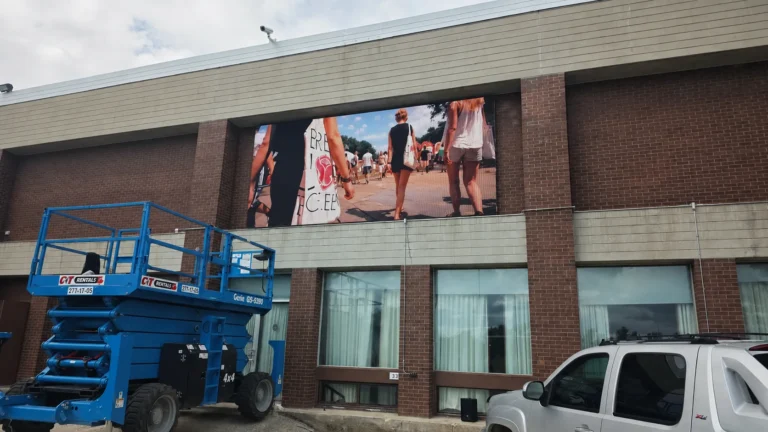
For years, Class A was the norm for LED screens, and rightly so. A screen installed high up in a stadium, far from any home radio or TV receiver, has no reason not to be a Class A product. On a stadium LED display or a digital LED billboard, Class A remains the appropriate level.
In practice, under EN 55032:2015 (amendment A11:2020), radiated emissions measured at 10 metres must not exceed 40 dBµV/m from 30 to 230 MHz and 47 dBµV/m from 230 MHz to 1 GHz for Class A, against 30 and 37 dBµV/m for Class B. Class B is therefore 10 dB stricter, roughly a third of the field strength.
Why does fine pitch LED change the rules?
As pixel pitches shrink, LED screens are moving indoors and closer to people: boardrooms, television studios, private cinemas and now living rooms, where LED sometimes replaces the television. When a screen is intended mainly for a residential environment, it should meet the stricter Class B limits.
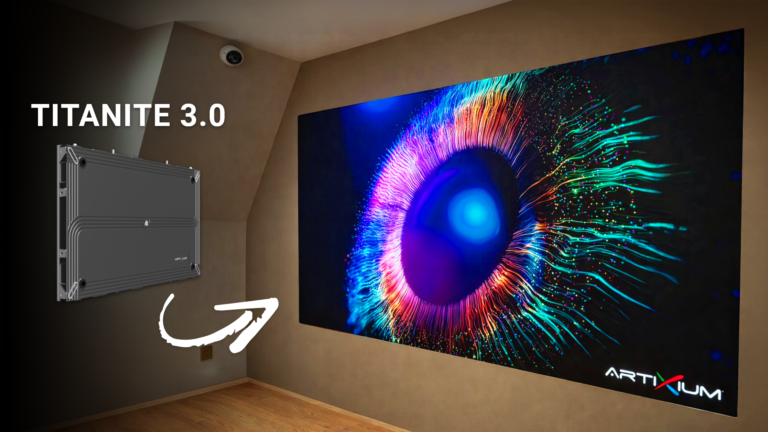
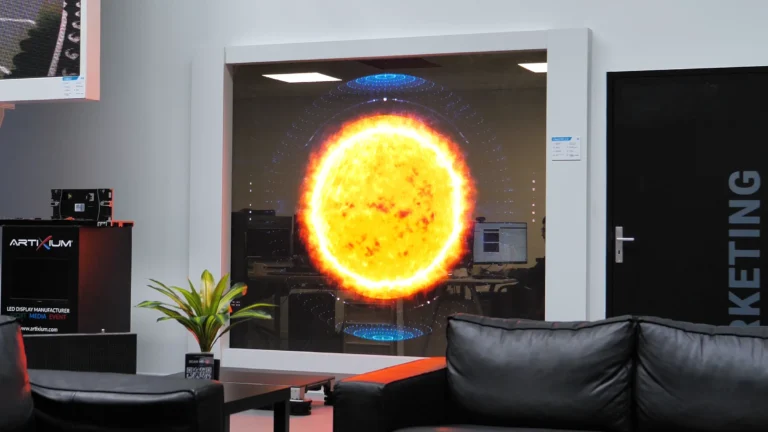
This concerns ultra fine pitch displays such as Titanite 3 and Cadmium, corporate LED displays, broadcast studios where sensitive audio and radio equipment work close to the screen, and all-in-one home cinema screens such as Solstice. For these projects, the EMC class should be checked from the very start, just like pixel pitch or brightness.
What does it take to reach Class B?
Class B is not simply a better-looking certificate. It often requires improvements across the whole design:
- power supply design;
- PCB layout;
- grounding and bonding;
- shielding;
- data and power cabling;
- receiver card installation;
- complete system integration.
The whole display system must be considered, not a single module or cabinet in isolation. Installation quality matters too: cable routing and grounding done during LED screen installation affect the emissions of the finished screen, as do the control system and accessories chosen.
Why test the screen as it will actually be used?
EMC compliance is not always taken seriously in the LED display industry. Clifford Rickman describes a panel submitted for testing while running its built-in test pattern. It passed, and the manufacturer presented that result as proof of compliance. Tested again while playing real video, the same panel exceeded the limit at many frequencies, with a worst peak around 77 dBµV/m against a 50 dBµV/m limit: 27 dB over, more than twenty times the permitted field strength. Not a borderline failure, but a completely different result, simply because the screen was being used as a screen.
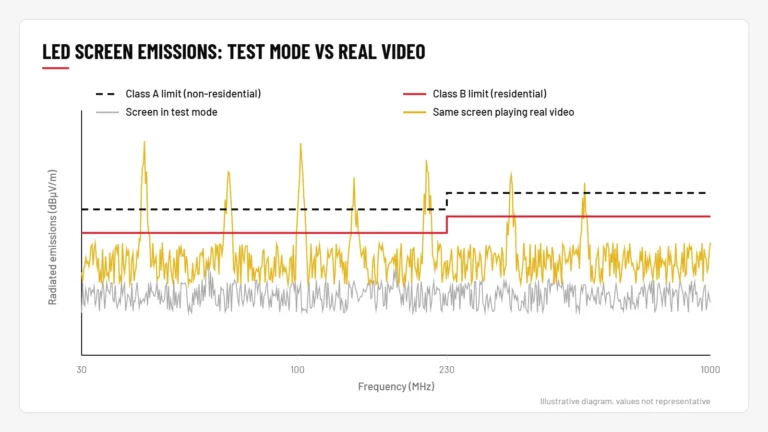
CISPR 32 states that emissions should be measured in a way consistent with the equipment’s typical arrangement and use. An LED screen is meant to display changing images and moving video, not a convenient factory test pattern. Its emissions can change considerably with:
- the image or video displayed;
- refresh rate and grayscale settings, explained in our guide to refresh rate;
- brightness and current demand;
- receiver card and driver IC activity;
- power supply loading;
- data and power cable arrangement;
- the number of cabinets operating together.
The test report should clearly state the screen’s operating mode and how its ports were exercised. A pass in a specially chosen test mode does not prove that the finished screen will pass while showing normal video at its advertised brightness and refresh rate.
What rules apply in the United States?
The United States uses a similar distinction under FCC Part 15. FCC Class A covers digital equipment marketed for commercial, industrial or business environments. FCC Class B covers equipment marketed for residential use, even if it can also be used commercially. Its limits are tighter, for the same reasons. FCC requirements cover both radiated emissions and conducted emissions returned through the mains.
FCC Part 15 and CISPR 32 are not identical: limits, measurement distances and test procedures differ. Passing CISPR 32 does not automatically prove FCC compliance, and an FCC result cannot simply be relabelled as CISPR compliance. The message is the same on both sides of the Atlantic, though: a screen marketed for homes should be designed and properly tested as a Class B product.
The figures show it: under FCC section 15.109, Class B is measured at 3 metres, with limits from 100 µV/m between 30 and 88 MHz up to 500 µV/m above 960 MHz, while Class A is measured at 10 metres, with limits from 90 to 300 µV/m.
What should you ask your supplier about LED display EMC?
- Which EMC class does the screen meet, Class A or Class B?
- Was it tested as a complete screen or as a single module or cabinet?
- Which operating mode was used during the test: test pattern or real video?
- At what brightness, refresh rate and grayscale settings?
- Which receiver cards, power supplies and cabling were used?
- For the United States, is there a dedicated FCC Part 15 report?
A test certificate only means something if the product tested represents the product you will actually use. For a meeting room, a studio or a home cinema project, our team can answer your compliance questions: come and see our screens in our showroom or tell us about your project.
Frequently asked questions about LED display EMC
What is the difference between Class A and Class B EMC?
Class A covers equipment used outside residential environments, such as stadiums, shops and offices. Class B covers equipment used in homes and has tighter emission limits, because the screen may operate close to televisions, radios and Wi-Fi equipment.
Can a Class A LED screen be installed in a home?
Class A equipment carries a warning that it may cause radio interference in a residential environment. For a screen intended mainly for a home, such as a private cinema or a living room, a Class B screen is the appropriate choice.
Which standard covers LED screen emissions in Europe?
In the European Union, emissions from multimedia equipment such as LED screens are assessed under EN 55032, the European version of CISPR 32, as part of the EMC Directive and CE marking.
Why does the test mode matter?
An LED screen’s emissions change with the content displayed, brightness, refresh rate and electronics activity. A screen that passes on a factory test pattern can exceed the limits when playing real video. The test should reflect normal use.
Is CISPR 32 compliance enough for the United States?
No. The United States applies FCC Part 15, whose limits and test methods differ. Each market requires its own demonstration of compliance.
What sources is this guide based on?
This guide draws on the article by Clifford Rickman, an LED display and lighting engineer specialising in PCB, thermal and structural design: As LED Screens Move into the Home, Is Class A EMC Still Good Enough?, published on LinkedIn in September 2026. His conclusion: for LED to become a genuine domestic product, Class B compliance under representative conditions must be part of the original design, not a line in the marketing material. Our thanks to him. Read his other insights in our guides on flip chip LEDs, LED screen contrast and the history of LED.
- Clifford Rickman, As LED Screens Move into the Home, Is Class A EMC Still Good Enough?, LinkedIn, 18 September 2026.
- European Union, Directive 2014/30/EU on electromagnetic compatibility, 26 February 2014.
- EN 55032:2015 (CISPR 32:2015), amendment A11:2020: emission limits for multimedia equipment.
- United States, 47 CFR § 15.109 (FCC Part 15): radiated emission limits.