By the Artixium technical team · Updated 16 October 2026
Why Does It Matter for Your Projects?
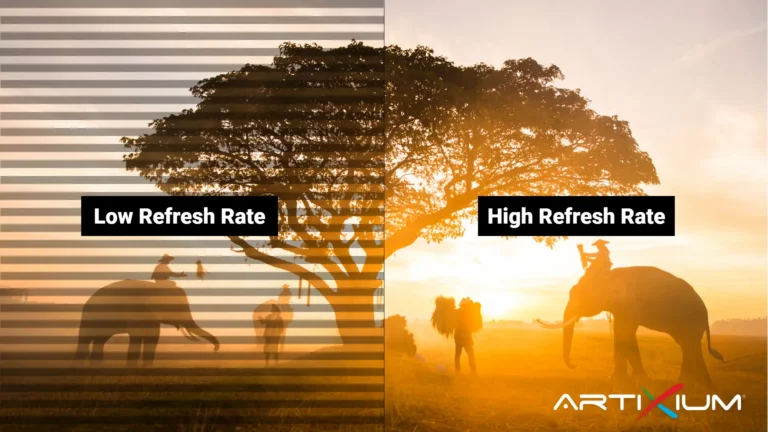
The LED refresh rate is the number of times per second the screen redraws its image, measured in hertz (Hz). For a screen that will be filmed or broadcast, aim for at least 3840 Hz. Below that, cameras can pick up flicker that nobody in the room can see.
What Is the LED Refresh Rate?
Refresh rate tells you how many times per second the screen redraws the image. It is measured in hertz (Hz): the higher the value, the steadier the image.
Two related terms often get mixed up with it. Frame rate comes from the source: a camera, a computer or a video file sends, say, 50 or 60 frames per second. Scan rate describes how the screen drives its LEDs line by line, with ratios such as 1/8 or 1/16. At 1/8, more LEDs are lit at the same time than at 1/16, which gives more brightness and stability.
A concrete case: a video produced at 60 Hz, shown on a screen refreshed at 7680 Hz with a 1/8 scan. The image stays clean to the naked eye and on camera.
Where Does It Make a Difference?
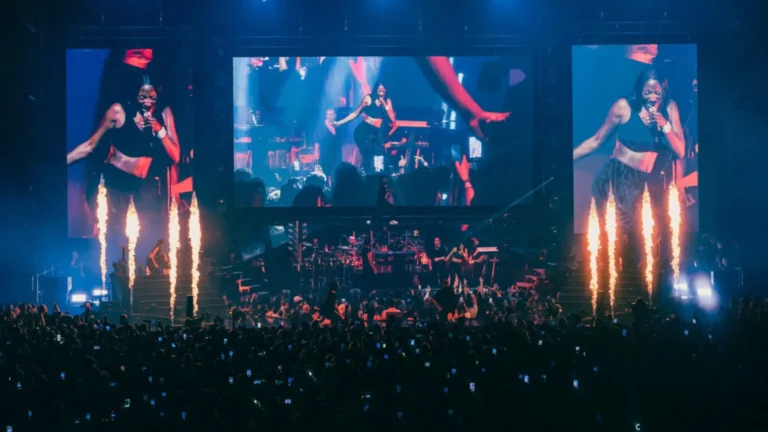
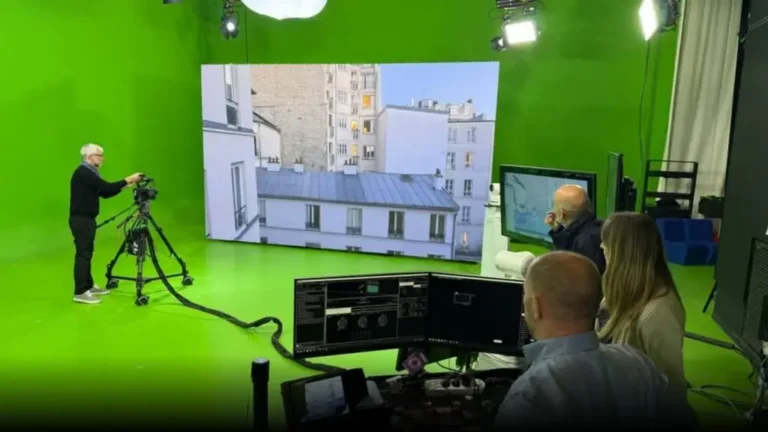
On a TV set or during a shoot, a low rate shows up straight away on screen: flicker, black bands rolling across the picture. The audience in the room sees nothing, but the camera records the defect.
In a stadium the stakes are the same for broadcasts, because the boards around the pitch are filmed all match long, often in slow motion. At a live event, a high rate also avoids artefacts when the content moves fast.
How Do You Read the LED Refresh Rate on a Datasheet?
Most manufacturers print a single figure, for example 3840 Hz. Ask two questions before you compare it with another offer.
First, at what grey level was it measured? Some driver chips only hold their top rate at full brightness and lose it once the screen is dimmed for a TV set or a dark room. Second, which driver chip sits on the modules? Together with the receiving card settings, that chip sets the LED refresh rate far more than the video processor does.
If the supplier cannot answer, ask for a video of the screen filmed at a fast shutter speed, or better, a test on site. Flicker shows up on camera within seconds.
What Values Does Artixium Offer?
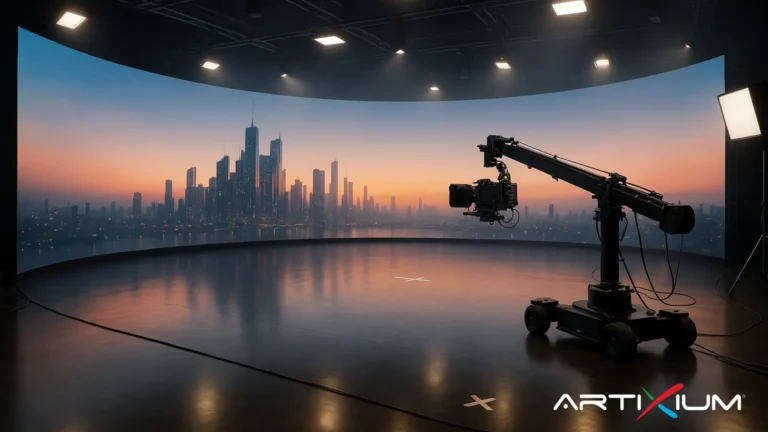
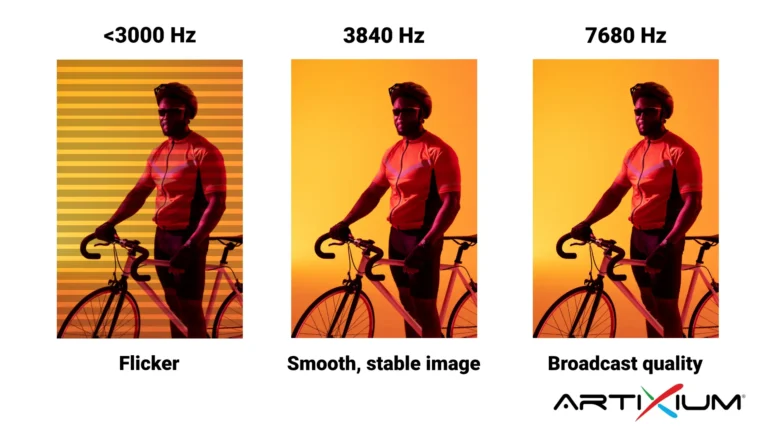
A good refresh rate starts at 3840 Hz. At Artixium, screens such as Beryl XR and Neipatec ST reach 7680 Hz, which meets the requirements of broadcast and international sports events.
Comparing several offers? Ask for the measured LED refresh rate, not just an “up to” figure, and test the screen with the production camera before you sign.
Frequently asked questions
What refresh rate should a filmed LED screen have?
For filming and TV broadcast, aim for at least 3840 Hz. Below that, the camera can pick up bands or flicker that nobody sees on site. For virtual production and sports broadcasts, our screens such as Beryl XR reach 7680 Hz.
Does the LED refresh rate depend on the video being played?
No. The source sends frames at its own pace, often 50 or 60 per second. The LED refresh rate measures something else: how many times per second the screen electronics relight the LEDs to show each frame. Wikipedia covers the general idea of refresh rate.
Why does an LED screen flicker on camera?
LEDs are driven by pulse-width modulation: they switch on and off very quickly to set brightness. If the camera shutter is faster than that cycle, it catches moments when some LEDs are off. A higher rate lowers the risk, and shutter speed settings matter too.
Is a high refresh rate enough for a good picture?
No. It keeps the image steady, but grey levels, brightness, contrast and uniformity between modules matter just as much. Depending on the driver chips, pushing the refresh rate can even reduce grey detail at low brightness. A good screen strikes the balance.
How can I check this value before buying?
Read the datasheet, then ask how the value was measured. The most reliable check is a test with the production camera and its settings. You can also compare our screens in real conditions at our showroom near Lyon.