By the Artixium technical team · Updated 14 October 2026
In a MicroLED or fine pitch LED display, the red, green and blue LEDs of each pixel look like three versions of the same component. They are not. Blue and green are made of InGaN (indium gallium nitride), while red is usually made of AlGaInP (aluminium gallium indium phosphide). That difference explains why red loses more light as the screen heats up, why it becomes harder to make as LEDs shrink, and why it is one of the biggest challenges for MicroLED. This guide explains the problem, what it means for colour accuracy, and the new approaches, such as a single LED able to produce every colour, that could change how a pixel is built.
What is MicroLED?
MicroLED refers to displays built from very small, self-emissive LEDs: each pixel produces its own light, with no backlight. The term covers two very different worlds:
- Large-format direct-view displays with a pixel pitch below about one millimetre, used for meeting rooms, control rooms and studios. Our Titanite 3, Titanite Access and Cadmium belong to this MicroLED and ultra fine pitch family.
- Microdisplays a few millimetres across, with emitters of a few microns, designed for augmented reality glasses.
In both cases, the LEDs are often mounted directly on the board, as explained in our guides What is COB technology? and flip chip LED.
Why are red, green and blue LEDs not the same?
An LED screen builds every colour by mixing red, green and blue light. To produce a correct white, the three colours must stay in the right balance.
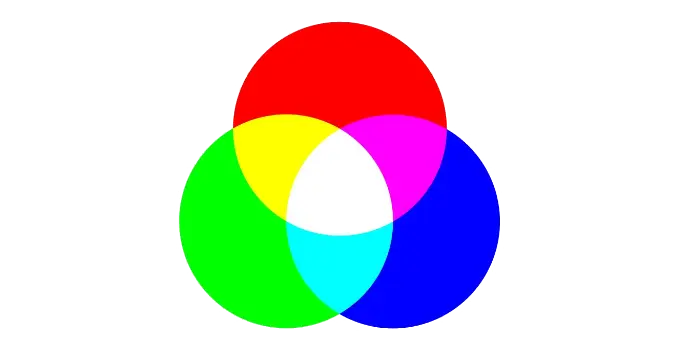
The difficulty is that the three LEDs do not come from the same semiconductor family. Blue and green, which made full-colour screens possible in the 1990s as told in our history of LED guide, are based on InGaN. Red relies on AlGaInP, a material that has been very successful for efficient red LEDs, but which behaves differently from its InGaN neighbours.
Why does the red LED lose light as it heats up?
As junction temperature rises, the efficiency and light output of an AlGaInP red LED can fall significantly. This is known as thermal droop. InGaN blue and green LEDs are generally more stable with temperature.
For a display manufacturer, the consequence is subtle. A white pixel depends on the balance of red, green and blue, but the three do not change equally as the screen warms up. A screen perfectly calibrated when cold can therefore drift once it reaches operating temperature, with red behaving differently from green and blue. The result is not only lower brightness, but a colour balance problem.
Good manufacturers compensate with careful thermal design and calibration. This is why serious LED screen calibration is carried out once the screen has stabilised at its operating temperature. Yet this remains compensation for a physical difference that starts in the materials themselves. Better heat removal, as offered by flip chip LEDs, also helps limit the drift.
Why does red suffer more as LEDs shrink?
The problem grows at MicroLED scale. As an LED shrinks, its perimeter becomes large compared with its emitting area. Defects on the sidewalls and surface recombination, where charge carriers are lost without producing light, become increasingly significant. AlGaInP red MicroLEDs are particularly affected.
One of the great challenges of microscopic RGB displays can therefore be summed up simply: how do you make red behave like green and blue? The obvious answer would be to make red from InGaN as well. But producing efficient red light from InGaN has long been difficult: the extra indium needed to shift emission towards red creates strain and other material problems.
PoroGaN®: can a red LED be made from InGaN?
This is where Porotech, a spin-out from the University of Cambridge, comes in. Its PoroGaN® technology uses a porous gallium nitride structure that relieves strain in the semiconductor. With it, Porotech has demonstrated red emission from the InGaN material system.
Red, green and blue would then no longer need to come from two fundamentally different semiconductor technologies. That alone could have major implications for MicroLED manufacturing.
Can a single LED produce every colour?
Porotech has gone further with Dynamic Pixel Tuning (DPT®). Instead of building a pixel from three separate LEDs, the company says a single InGaN MicroLED can electrically tune the wavelength it emits. The same emitter can produce red, green or blue. The colours are displayed one after another at high speed, and our visual system blends them into the required colour.
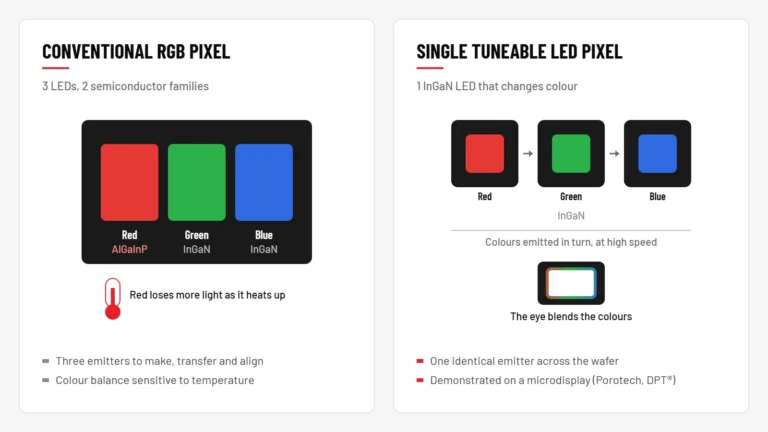
Porotech demonstrated this in May 2023 on a 0.26-inch monolithic 1280 × 720 MicroLED microdisplay; according to Clifford Rickman, its emitters measure 3.5 µm on a 4.5 µm pixel pitch. Why does it matter? Conventional MicroLED manufacturing must produce, position, transfer, connect, test and correct millions of microscopic red, green and blue emitters with extreme accuracy. If one semiconductor structure can produce every colour:
- identical pixels could be made across a whole wafer;
- manufacturing could become simpler;
- yield could improve;
- pixel density could increase;
- each colour could use the full emitting area, since the pixel is no longer split into three subpixels.
Could displays go beyond RGB?
The display industry has thought in three primary colours for decades because the hardware contained three types of emitter. If the emitter itself becomes tuneable, nothing requires sticking to red, green and blue. A future display could use, for example, red, amber, green, cyan and blue, or another combination optimised for a given colour space. Extra primaries would come from the drive electronics rather than from extra LED dies.
That could affect colour gamut, spectral optimisation and future display standards, with obvious interest for broadcast studios and virtual production, where screens like Beryl XR must reproduce colours faithfully on camera.
Is the tuneable LED a revolution or a promise?
Big questions remain. A laboratory demonstration and mass production are very different things. To reach mainstream LED displays, the technology will need competitive efficiency at every wavelength, enough brightness, long-term stability, predictable thermal behaviour, good yield and commercially viable wafer production. There is also a driver challenge: if drive conditions set the wavelength, brightness control has to work alongside colour selection. For large direct-view displays, instantaneous brightness and long-term reliability will be critical.
It is not just a laboratory curiosity, though. Porotech works with semiconductor manufacturers including Foxconn and PSMC, and has developed an 8-inch MicroLED manufacturing platform. In December 2024, Foxconn announced with Porotech a MicroLED production line in Taichung, Taiwan, targeting mass production from the fourth quarter of 2025; Clifford Rickman notes he had not found confirmation that volume production started on that schedule. The immediate focus is augmented reality and ultra-high-density microdisplays, even if Porotech also lists televisions and large signage among its applications. Conventional RGB LEDs are not about to disappear.
What does MicroLED mean for your LED screen project today?
For a screen installed today, proven RGB technology remains the reference. What matters is how well the manufacturer masters the red LED issue:
- Colour stability when warm: ask how white balance holds once the screen reaches operating temperature.
- Thermal design: a screen that runs cooler drifts less, as explained in our guide to flip chip LEDs.
- Calibration: check how the screen is calibrated at the factory and on site, and how often.
- Contrast and black level: colour accuracy also depends on them, see our guide to LED screen contrast.
For a meeting room, a control room LED video wall or a studio, our MicroLED and ultra fine pitch displays such as Titanite 3 and Cadmium can be seen in our showroom. Tell us about your project and our team will advise you.
Frequently asked questions about MicroLED
What is MicroLED?
MicroLED refers to displays made of very small self-emissive LEDs. The term covers large direct-view screens with a pixel pitch below about one millimetre, used in meeting rooms, control rooms and studios, as well as microdisplays a few millimetres across for augmented reality.
Why does an LED screen’s colour change as it heats up?
Red LEDs are usually made of AlGaInP, whose light output drops more with temperature than that of the InGaN green and blue LEDs. As the screen warms up, the balance between the three colours shifts. Thermal design and calibration at operating temperature limit this drift.
Why is the red LED harder to miniaturise?
As an LED gets smaller, its edges become large compared with its emitting area. Sidewall defects and surface recombination then waste more energy, and AlGaInP red MicroLEDs are particularly affected.
What is Porotech’s PoroGaN technology?
PoroGaN® is a porous gallium nitride structure developed by Porotech, a University of Cambridge spin-out. By relieving strain in the material, it has allowed red light to be produced from InGaN, the material already used for green and blue.
Are single tuneable LED displays available?
Not in large-format LED displays. Porotech has demonstrated a 1280 × 720 MicroLED microdisplay in which one InGaN emitter produces red, green and blue, and is targeting augmented reality first. Industrial production for large screens remains to be proven.
What sources is this guide based on?
This guide draws on the article by Clifford Rickman, an LED display and lighting engineer specialising in PCB, thermal and structural design, published on LinkedIn in August 2026: For decades, the LED display industry has lived with a fundamental compromise. He states that he has no affiliation with Porotech or Foxconn. His conclusion: if a single LED can produce every colour at scale, we will no longer be trying to make three different LEDs behave like one pixel; the LED itself will become the pixel. Our thanks to him. Read his other insights in our guides on LED display EMC, flip chip LEDs, LED screen contrast and the history of LED.
- Clifford Rickman, For decades, the LED display industry has lived with a fundamental compromise, LinkedIn, 25 August 2026.
- Porotech, official website (PoroGaN® and DPT® technologies).
- MicroLED-Info, demonstration of Porotech’s 1280 × 720 DPT microdisplay, 18 May 2023.
- MicroLED-Info, Foxconn to build a microLED microdisplay fab in Taiwan based on Porotech’s DPT technology, 24 December 2024.