Retail LED display
A retail LED display catches the eye from the street and brings the store to life: in a shop window it must stay readable in daylight and be serviced without closing the shop. Artixium designs LED displays for shop windows, storefronts, shopping centres and quick-service restaurants.


Which LED displays for a store?
LED displays that hold attention at street level and carry the brand inside the store.
LED shop windows
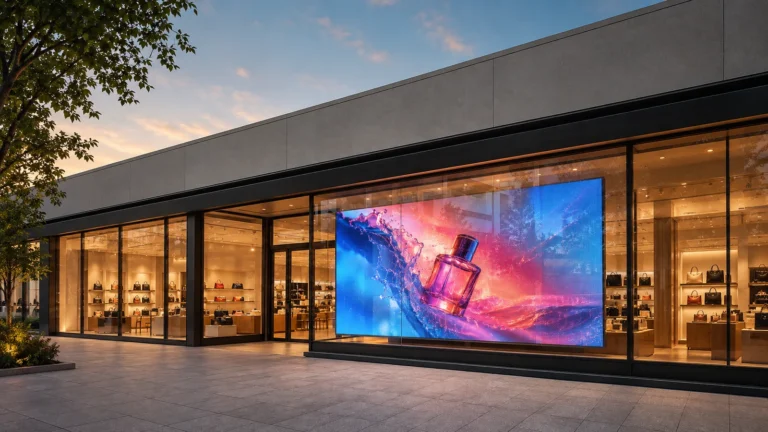
Shop-window LED displays read from the pavement in full daylight, sized to the glazing and serviced from inside the shop.
In a shop window everything comes back to light. The sun lights the front and reflects off the glass while the screen still has to read from the street. That takes several thousand nits to hold at midday, and the ability to drop very low in the evening so it does not glare at passers-by once the shop is shut.
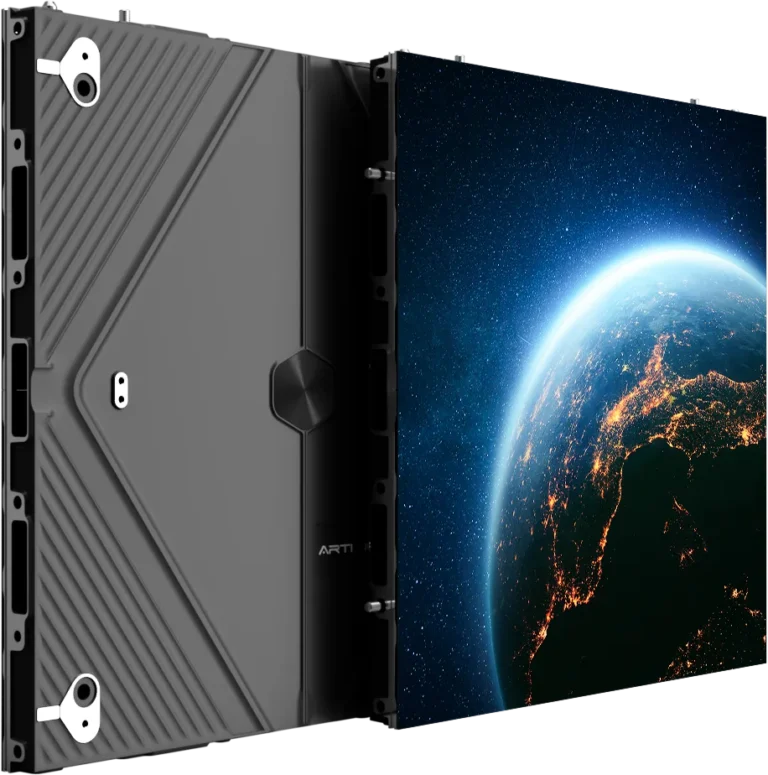
The Thorite 3 is the cabinet we fit most often behind glazing: outdoor-grade brightness, an ambient light sensor that adjusts the panel continuously, and front service from inside the shop, without dismantling the shopfront.
The mounting follows the window. The screen hangs from the ceiling when the floor has to stay clear for the display, or stands on a floor structure when the ceiling cannot take the load.
LED facades
A screen on the facade, above the door or in place of the sign: read from the opposite pavement and from the road, in full sun and after dark.
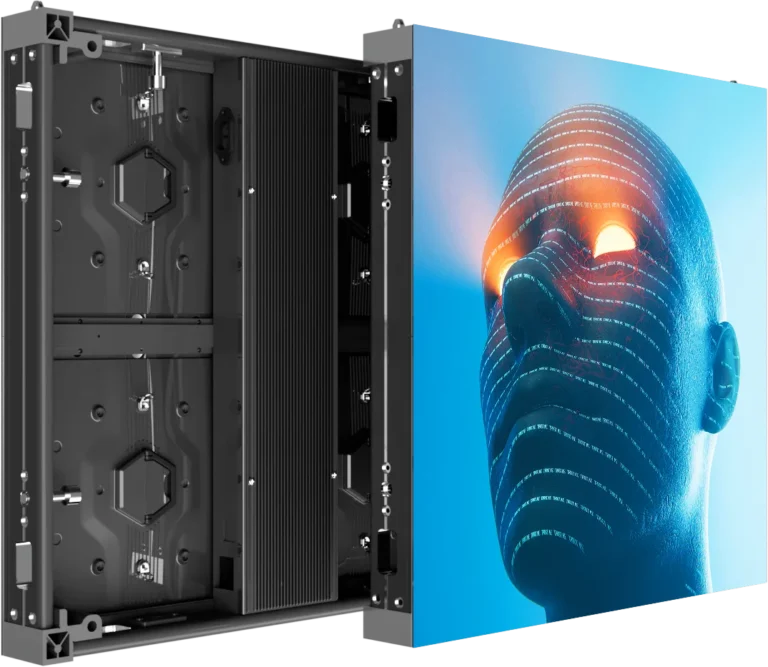
On a facade the screen is outside. It takes rain, frost and direct sun: our facade cabinets are tested and IP68 certified, the highest rating against water and dust. That leaves the light. The panel must not drown in reflections, the brightness has to stay readable in full sun, and it has to come back down at night so it does not disturb the neighbours. That is usually handled by a sensor set in one corner of the screen: it reads the ambient light and adjusts the panel continuously.
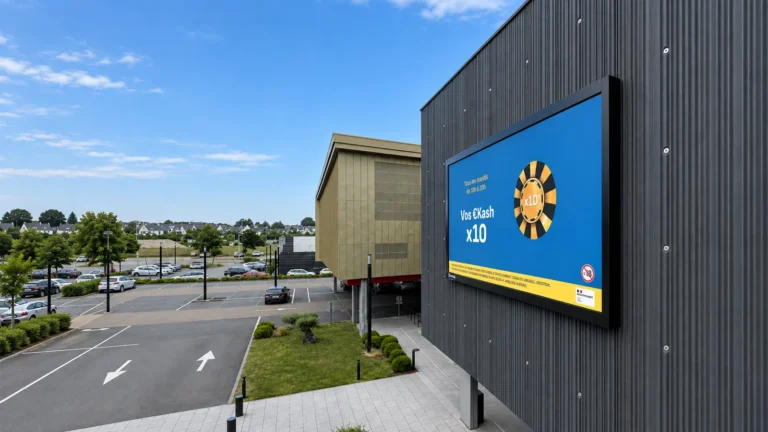
The Thorite 3, at 3.9 to 4.8 mm, covers the shopfronts read from the opposite pavement. As soon as the screen has to carry further (a sign read from the road, or from the far side of a car park), the Cobalt takes over: its 8.3 to 10 mm pitch is built for those distances, and it covers larger sign areas with it. Both are front-serviced: a module is replaced from the street, without touching the facade.
Transparent displays
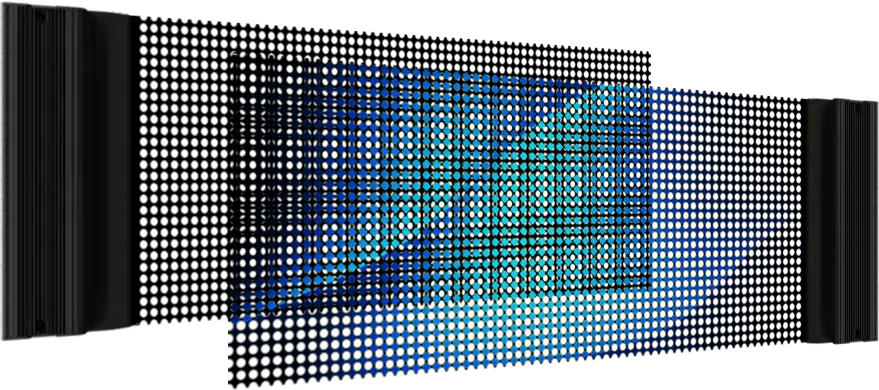
A screen that leaves the glass a window: content on the street side, daylight and the view into the shop preserved.
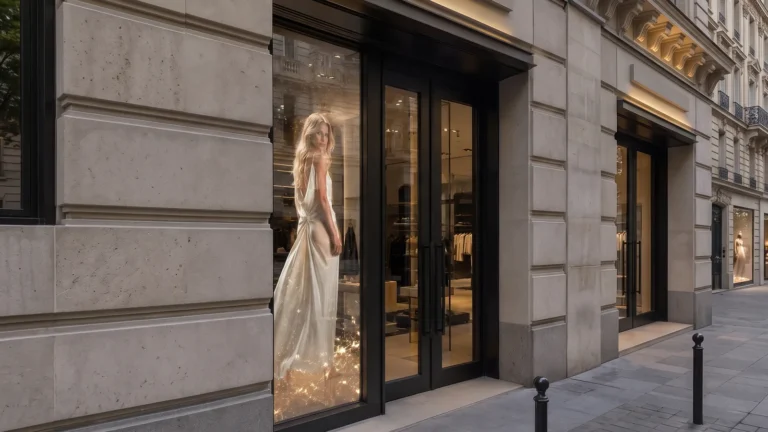
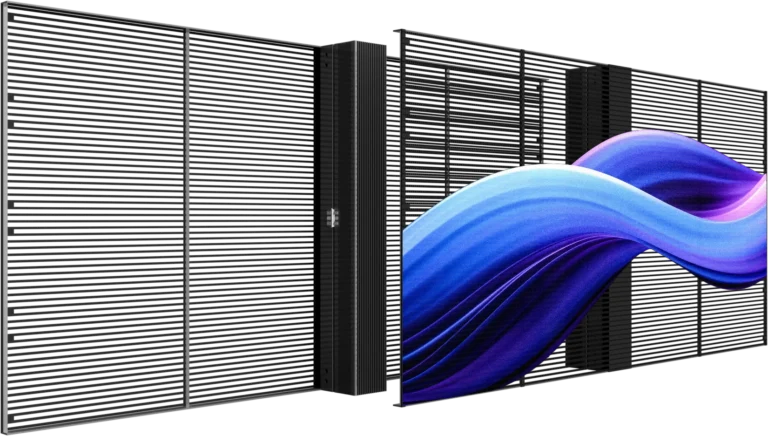
Transparency is bought with open area between the LED strips. The more open it is, the more daylight passes and the lighter the structure; the more closed, the denser the image. The right trade-off comes from the reading distance and from how much of the window you want to keep clear.
The Neon Outdoor sits behind street-facing glazing and the Neon indoors: both fix to the glass rather than replace it. The Calcite 2 works differently: it bonds straight onto the pane like an adhesive film, with no structure and no added load.
LED unipoles
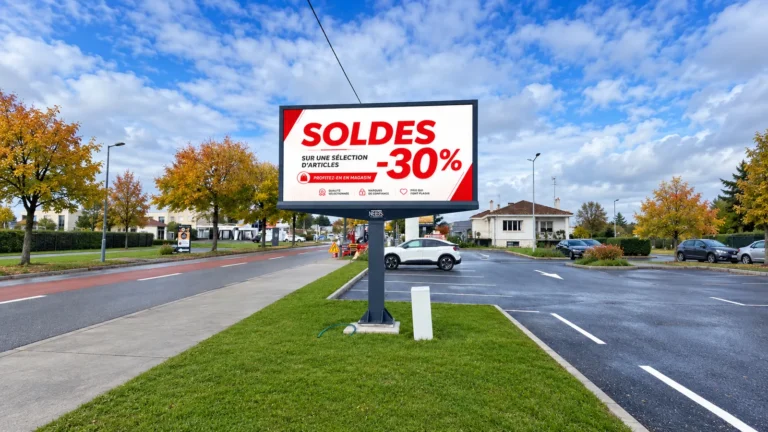
A screen on its own mast, at the entrance to the car park or along the road: seen from a moving car, at a distance, in any weather.
A unipole is read on the move. The message has a few seconds, and the pixel pitch follows the reading distance, not the screen area. The mast carries the whole wind load, so we design the structure ourselves, made to measure from the screen size you ask for: the calculation is part of the order, not an end-of-job formality.
The Thorite 3 covers the usual formats, the Cobalt the large ones. Both can be serviced from the front or from the back: you work from whichever side the mast leaves accessible.
LED columns
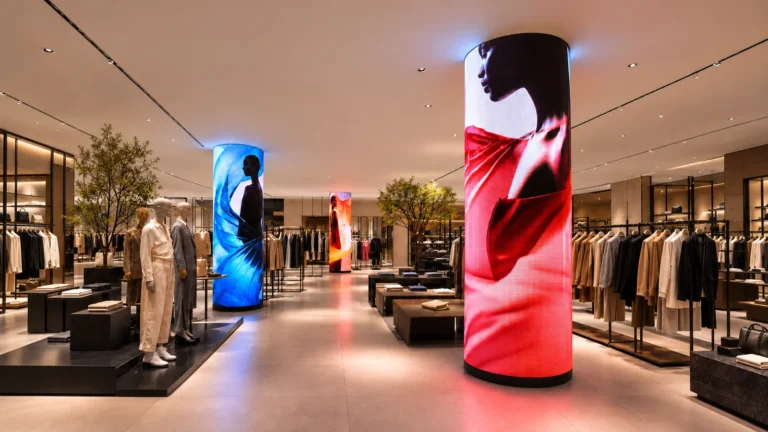
LED fitted to an existing column, timber or concrete: a structural post in the shop becomes a display surface, read while walking past.
A structural column is not a wall. It is round or sharp-edged, usually already clad, and shoppers pass within a metre or two. The screen has to follow that shape, stay thin so it does not thicken the post, and carry a fine pixel pitch because it is read from close up.
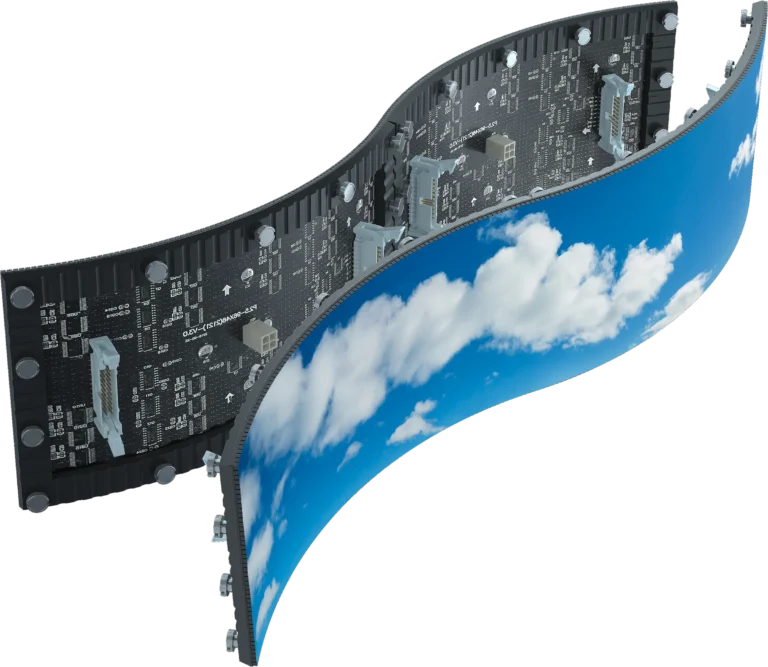
The Mica flexible modules go straight onto the shaft, timber or concrete: they follow the column’s radius without an added frame, so the cladding keeps close to its original diameter.
360° LED rings
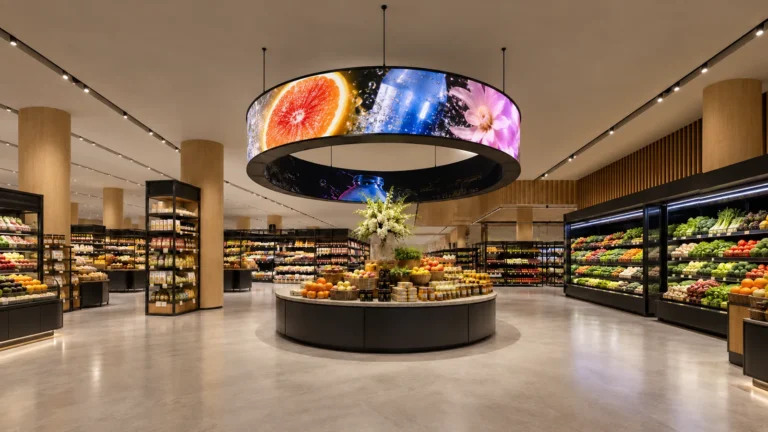
A closed curve. A ring above a display, a cylinder around a post, a curved wall: content with no edge and no starting point.
A ring does not have to be a perfect circle. Each cabinet curves on its own, so the screen follows the real shape of the place: an oval, a radius that varies, a curve closing around a post that is not round. That is LED’s advantage over rigid cladding, which imposes its own geometry. The content is then produced for a surface with no left and no right.
Suspended over a display table, wrapped around a structural post or closing a corner, it reads from every point in the shop, which is why it marks a place rather than carrying text.
The Qwartz 3 and the Granite have bevelled edges: set side by side, they describe a curve with no visible break. The Mica flexible modules take over on the tighter radii, and beyond that the ring becomes a custom LED project: shape, cabinet and structure are drawn with you.
Point-of-sale LED
Small formats at arm’s length: shelf edges, till surrounds, display plinths and product walls.
At half a metre the pixel pitch has to disappear, and the screen has to sit in the furniture rather than on a wall: shallow, discreetly framed, and in a format that follows the shelf or the counter rather than a standard template.
The Titanite Access goes down to 1.25 mm: it is the one to reach for when the screen is read at half a metre, on a shelf edge or a till surround. The Qwartz 3 follows from 1.5 mm, and the Granite from 1.9 mm for the wider areas: a product wall, a till backdrop. All three are front-serviced and driven from the same source as the rest of the store’s screens.
Digital signage
The screens that run all day inside the shop: promotions, wayfinding, menus and queue information.
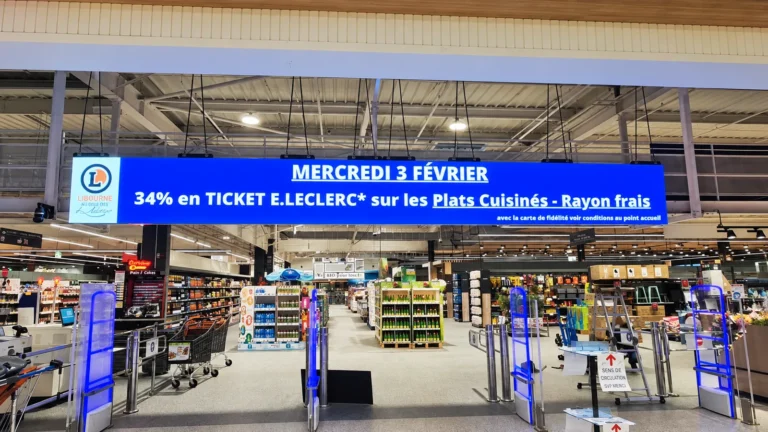
These run every trading hour of the year, which makes service access and colour consistency the real questions. A wall that cannot be reached without closing an aisle will not be maintained; a set of screens that drift apart in colour reads as a fault.
The Qwartz 3 and the Granite are front-serviced, so a failed module is changed from the shop floor without scaffolding and without shutting the aisle.
LED displays for every kind of retail space
Artixium manufactures LED displays for independent stores, shopping centres, luxury houses and restaurant groups: one screen in a window, or a calibrated set across an estate.
Shopping mall
Main concourse, entrances, escalator landings or food court: the screen goes where the flow slows down, hung over the walkway or set into a wall.
Your project first
The product choice starts from your request and your project. The first question is whether the screen will be outside or inside: they are not the same cabinets, not the same brightness, not the same sealing, not the same servicing.
The expected finish
Then comes the finish the space calls for. In premium retail the screen has to be forgotten: set into the wall, with no visible frame, silent, and perfectly black once it is off. On a fast-food line it is production equipment: it has to be repairable from the front, in minutes, without closing the counter.
Luxury boutique
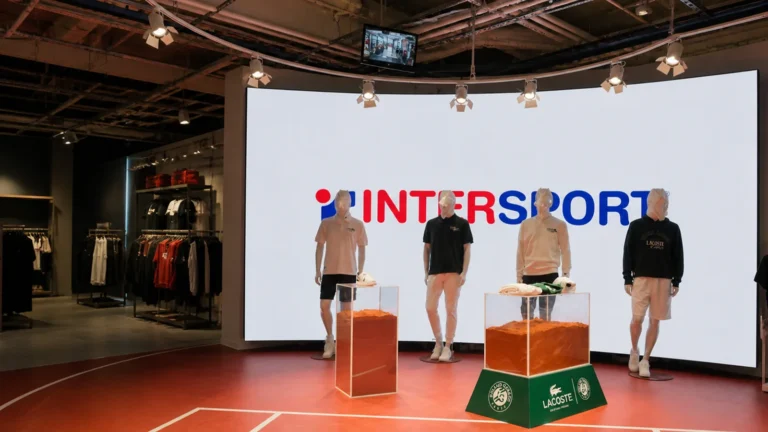
A fine pixel pitch, for an image with no visible grid at a metre. That is what keeps brand visuals sharp, even seen from very close.
Restaurant & QSR
Menus and prices, dish of the day, evenings and events: the content changes through the day and is updated remotely.
The scale of the network
That leaves the scale of the project. A single shopfront or a network of forty stores are both ordinary work for us. The network adds one requirement: that all forty screens show exactly the same colour, and that is what becomes the real engineering question.
Car dealership
High-brightness screens, built to be read from passing traffic. In dense retail zones, that is what sets the dealership apart from the signs around it.
Need advice ?
Our retail LED display projects
Why choose Artixium for a retail LED display?
Artixium helps retailers move from a shopfitting brief to an operational LED display, with products chosen for the space and long-term maintenance.
Manufacturer, not reseller
We design and build our own LED range. Product choice, lead times and spare modules all come from the same contact, with no intermediary.
Up to 5 years' warranty
Our screens are covered by a warranty of up to 5 years. Across a store estate, that is what makes the running cost predictable.
A curved screen, a ring, a display on a column or bonded to glass: we design the shape, the cabinet and the structure for the space itself.
Every cabinet and every LED batch is traced at manufacture. Years later, a replacement module matches the one already in place.
Our retail LED display products
Visit our showroom
- Plan your visit
Configure your LED screen
- Configure my screen
Frequently asked questions
How bright does a shop window display need to be?
Bright enough to compete with the daylight falling on the glass. A storefront in direct sun needs far more brightness than one under an arcade; the level is set from the orientation and the glazing rather than from a catalogue figure.
Can the screen be serviced without closing the shop?
Yes. Front-access modules let a display sit flush against the window or wall and still be serviced from inside, so maintenance does not mean dismantling the storefront.
Can you install outside opening hours?
Yes. Night and early-morning windows are routine in retail and shopping centres, and are planned into the deployment sequence from the start.
Can one system drive a whole store network?
Yes. Content can be managed centrally and pushed per store, per region or per format, so promotions run consistently across the network while local messages stay possible.
How much does a LED screen cost for a shop window?
The price depends on surface area, model, transparency level, pixel pitch and installation constraints. Artixium can provide a project estimate after reviewing the site and expected use.
Can a transparent LED display replace the shop window itself?
No. It is installed on the existing glass surface. With transparent LED technology, products remain visible from outside while dynamic content can be displayed.
Do I need a permit for a LED display in my shop window?
In France, installing a LED display in a store window is subject to illuminated signage regulations (decree of September 30, 2012). For surfaces larger than 1 m² visible from outside, a prior declaration at the town hall is generally required. Artixium can support you through the administrative process.
How long does a storefront installation take?
A single window display is usually a one-day installation once the fixing and power are ready. What takes time is everything before it: the structural fixing, the cable route and, on a listed or shared frontage, the landlord”s or council”s agreement.
What warranty comes with a retail LED display?
Our warranty covers the cabinets and power supplies, and we hold spare stock for the installation”s life so a failure is a swap rather than a re-tender. For estates we contract a response time, because a dark screen in a flagship store is a commercial problem before it is a technical one.
Tell us about your store
Window, storefront or in-store: send the dimensions and the light conditions, and we come back with a specification.