LED display FAQ
Our LED display FAQ answers the questions we hear most: products, pricing, installation, repair, training and distribution. Search for a word or pick a category.
LED Displays (64)
What is a sport LED display?
A sport LED display is a screen system built for stadiums and arenas — perimeter boards, giant screens, scoreboards and ribbons — engineered for brightness, durability and broadcast.
What is a rental LED display?
A rental LED display is a modular, lightweight LED wall designed for temporary events: fast to rig and strike, easy to transport, and built to be reused show after show.
What is a plug & play LED display?
A plug & play LED display is an all-in-one screen with panels, processing and mounting integrated, so there is nothing to specify, source or assemble from separate parts — it runs like a standard display. Physical installation depends on the model: see the question below.
What is a virtual production LED volume?
A virtual production (VP) volume is an LED wall — often curved, sometimes with a ceiling — that displays a rendered environment, so scenes are captured in-camera with real talent and real lighting.
What is an indoor LED display?
An indoor LED display is a self-emissive screen built for interior use, with a fine pixel pitch and comfortable brightness for close viewing in lobbies, retail spaces, control rooms and meeting rooms.
What is a floor LED display?
A floor LED display is a walkable, load-bearing LED surface designed to be stepped on — used for stages, interactive installations, retail and immersive environments.
What is an outdoor LED display?
An outdoor LED display is a self-emissive screen engineered for exterior use: high brightness for daylight readability, a weatherproof (IP-rated) enclosure, and components rated for permanent installation on facades, buildings and public spaces.
Does Artixium rent LED screens?
No — Artixium is a manufacturer. We produce rental-series LED displays and supply them to rental companies, AV integrators and distributors, who deploy them for events and tours. Looking to hire screens for your event? We can point you to one of our partners.
Are perimeter LED boards broadcast-safe?
Yes. High refresh rates and accurate colour keep sponsor content flicker-free and camera-friendly for live broadcast.
Why does refresh rate matter for XR/VP?
High refresh and scan rates prevent flicker and banding when shooting at high shutter speeds, so the LED background records cleanly frame after frame.
Do I need an integrator to install it?
It depends on the product. "Plug & play" refers to the electronics: panels, processing and the media player are built in, so there is no signal integration to design and no specialist commissioning. Mounting is another matter. A pharmacy cross or a Smart City display goes outdoors, at height and on a mains supply — that calls for a professional installer. A Solstice stands on its own base or mounts on a wall, but its size makes a professional advisable. Our teams and our partner network handle the installation.
Can you walk on LED floor tiles?
Yes. Floor tiles use reinforced, anti-slip surfaces engineered to carry the weight of crowds and performers safely.
What pixel pitch is best for indoor LED?
Indoor displays generally use fine pitches (roughly P0.9–P2.5) because viewers stand close. The right pitch depends on the minimum viewing distance — our team recommends it for your space.
What brightness is recommended for an outdoor LED screen?
Direct-sunlight installations typically need 5,000-7,500 nits or more, while shaded or north-facing positions can use less. Artixium sizes brightness to the exact orientation and environment of each project.
What are the products available?
Artixium offers a comprehensive range of LED display products including indoor and outdoor LED cabinets, various pixel pitches from fine pitch (P1.25) to large format (P10+), rental and fixed installation solutions, transparent LED displays, curved and flexible displays, and complete turnkey solutions with control systems, mounting structures, and accessories.
Are sport LED displays weatherproof?
Outdoor stadium systems use weather-rated, impact-resistant cabinets designed for the demands of open-air venues and match-day use.
What pixel pitch is used for VP volumes?
Pitch depends on camera-to-wall distance and lens; VP volumes commonly use fine pitches to avoid moiré. Our team specifies it for your camera and stage.
How fast can a rental LED wall be set up?
Quick-lock panels assemble in seconds each, so a crew can build a large wall far faster than fixed installations — exact time depends on size and rigging.
Is the image quality as good as a custom LED wall?
Yes. Plug & play displays use the same fine-pitch LED quality as our custom systems, in a ready-to-run package.
Are LED floors interactive?
They can be. Optional motion sensors let the floor react to footsteps and movement for interactive, immersive experiences.
Are outdoor LED displays waterproof?
Yes. Our outdoor cabinets carry outdoor IP ratings (front and rear) so they withstand rain, humidity, dust and temperature swings for reliable year-round operation.
Is an LED wall better than an LCD video wall?
LED walls have no bezels or seams, so the image is continuous, and they offer higher brightness and longer life than tiled LCD — ideal for premium, always-on interior displays.
How many LEDs are there per display?
The number of LEDs per display depends on the pixel pitch and screen size. For example, a P2.5 display has approximately 160,000 LEDs per square meter, while a P10 display has about 10,000 LEDs per square meter. Each pixel typically contains red, green, and blue LEDs (RGB) to create full-color images.
Can rental LED panels be curved?
Yes. Panels include curve locks so you can build flat, concave or convex walls and creative shapes to match the stage design.
How bright should a stadium screen be?
Open-air stadium screens need high brightness to stay legible in daylight and on camera; Artixium sizes brightness to the venue and its broadcast requirements.
Do the panels support genlock and low latency?
Yes. Low-latency processing and genlock keep the LED content synchronised with the camera and the real-time render engine.
Where are plug & play LED displays used?
They suit retail, quick-service menus, corporate signage, reception areas and meeting rooms — anywhere a premium display should not be a complex project.
What pixel pitch should I choose for an outdoor LED display?
Pixel pitch follows viewing distance: larger pitches suit long-range facades and roadside signage, finer pitches suit close-up architectural and retail displays. Our team recommends the right pitch for your audience and distance.
Can floor and wall LED be combined?
Yes. Floor tiles pair with wall displays to build fully wrapped, immersive volumes for stages and installations.
Can indoor LED displays be curved or custom shapes?
Yes. Standardised cabinets assemble into flat, curved or custom shapes and ratios, so the display fits the exact architecture of the space.
What are the major specifications of the display?
Major specifications include: pixel pitch (distance between LED pixels), resolution, brightness (measured in nits), refresh rate (Hz), viewing angle, contrast ratio, color processing depth (bit), cabinet size, weight, power consumption, IP rating for outdoor models, and operational temperature range. Each specification impacts the display's performance and suitability for different applications.
Can the volume be flat and curved?
Yes. Cabinets assemble into flat walls, curved backgrounds and ceilings to build a seamless, immersive shooting volume.
How do I manage the content?
Content is managed through simple, familiar controls, so any team can update the screen like any other display.
Can you supply the full stadium system?
Yes. From perimeter and ribbon systems to giant screens and scoreboards, each element is specified for the venue, the sight lines and the sponsorship programme.
Are rental panels built for touring?
Yes. Cabinets, connectors and flight cases are engineered for repeated transport and rigging, with fast servicing to keep the show on schedule.
How are indoor LED displays maintained?
Front-access modules make servicing simple even when the display is mounted flush to a wall, keeping installation clean and maintenance fast.
Can an outdoor LED screen be customized?
Yes. Artixium engineers custom sizes, shapes and structures - flat, curved or bespoke - to integrate with the architecture and the constraints of the site.
Are floor LED displays durable?
Floor cabinets are built for heavy foot traffic with hard-wearing surfaces and simple servicing to stay reliable over time.
What is the contrast ratio of the display?
LED displays typically offer high contrast ratios ranging from 3000:1 to 8000:1 or higher. Contrast ratio is the difference between the brightest white and the darkest black the display can produce. Higher contrast ratios result in more vivid images with better detail in both bright and dark areas. Artixium displays feature advanced mask technology to enhance contrast performance.
How long do sport LED displays last?
Built for permanent stadium and arena installations, our sport displays are designed for a long service life and backed by up to a 5-year warranty and after-sales support in France.
How long does a plug & play LED display last?
Designed for permanent, always-on use, our plug & play displays are built for a long service life and backed by up to a 5-year warranty and after-sales support in France.
Can I mix screen sizes and shapes?
The modular system scales from a small backdrop to a giant screen and mixes ratios and shapes, so one panel type covers many event formats.
How long does an XR/VP LED volume last?
Built for permanent studio installations, our XR and virtual-production volumes are designed for a long service life and backed by up to a 5-year warranty and after-sales support in France.
How long does an indoor LED display last?
Built for permanent, always-on interior installations, our indoor displays are designed for a long service life and backed by up to a 5-year warranty and after-sales support in France.
How long does an outdoor LED display last?
Built for permanent professional installations, our outdoor displays are designed for long service life and backed by up to a 5-year warranty and after-sales support in France.
Are floor LED displays covered by a warranty?
Yes. Built for permanent, high-traffic installations, our floor displays are backed by up to a 5-year warranty and after-sales support in France.
What is the color processing bit rate?
Color processing bit rate refers to the number of bits used to process each color channel (red, green, blue). Artixium displays typically feature 14-16 bit processing, allowing for billions of color combinations and smooth color gradations. Higher bit rates result in more accurate color reproduction, smoother color transitions, and better image quality, especially in subtle gradients and skin tones.
Can rental LED displays be used outdoors?
Yes. Weather-resistant rental panels are available for open-air events and festivals, with the right IP rating and rigging specified for outdoor conditions.
Is the display equipped with shaders?
Yes, Artixium displays are equipped with high-quality masks (shaders) that cover the LED modules. These masks serve multiple purposes: they increase contrast ratio by reducing reflection of ambient light, protect the LEDs from physical damage and environmental factors, improve viewing angles, and enhance overall image quality. Different mask designs are used for indoor and outdoor applications.
What is the minimal viewing distance?
The minimal viewing distance is typically calculated as the pixel pitch in millimeters. For example, a P2.5 display has a minimum viewing distance of approximately 2.5 meters, while a P10 display requires about 10 meters. However, for optimal viewing experience without visible pixelation, the recommended distance is usually 2-3 times the minimum distance.
What is the recommended size and pitch for my location?
The recommended size and pixel pitch depend on several factors: viewing distance (closer viewing requires finer pitch), ambient light conditions (brighter environments may need higher brightness), content type (text requires finer pitch than graphics), budget, and installation space. Our team can provide detailed consultation to determine the optimal configuration for your specific application and location.
What is the cost reducing or increasing pixel pitch?
Finer pixel pitches (smaller numbers like P1.9, P2.5) are more expensive because they require more LEDs per square meter, more complex manufacturing, and higher precision. Larger pixel pitches (P5, P10) are more economical but suitable for larger viewing distances. The cost difference can be significant - a P2.5 display might cost 3-4 times more than a P10 display of the same size.
What is the color temperature of the white balance?
The color temperature of LED displays is typically adjustable and can range from 3000K (warm white) to 9000K (cool white), with 6500K being the standard for most applications as it represents daylight. Artixium displays allow for precise white balance calibration to ensure accurate color reproduction and can be adjusted to match specific ambient lighting conditions or customer preferences.
What is the color uniformity of the display?
Color uniformity refers to the consistency of color and brightness across the entire display surface. Artixium displays achieve excellent uniformity through careful LED binning, factory calibration, and advanced uniformity correction systems. Our displays typically maintain color uniformity within ±3% across the screen, ensuring a seamless image without visible patches or variations, even on large-format installations.
Why does artixium display have the best color reproduction?
Artixium displays excel in color reproduction through multiple factors: use of premium LED chips with tight binning tolerances, advanced color calibration systems, high bit processing (14-16 bit), factory calibration for each display, HDR support, wide color gamut coverage, and ongoing research in LED technology. Our displays are calibrated to industry standards and can reproduce colors accurately across the entire spectrum.
What is the life time of a display (not only LED)?
A complete LED display system typically has a lifetime of 10-15 years with proper maintenance. While LEDs themselves can last 100,000 hours, other components like power supplies, receiving cards, and cooling systems may need replacement during this period. Regular maintenance, proper operating conditions, and quality components significantly impact overall system lifetime. Artixium provides comprehensive support and spare parts throughout the display's lifetime.
What is the power consumption of a LED display?
Power consumption varies by pixel pitch, brightness settings, and content displayed. Typically, maximum power consumption ranges from 300-800W/m² depending on the model. Average power consumption during normal operation is usually 30-50% of maximum. For example, a 10m² P3.9 display might consume 4-5kW at maximum brightness but only 1.5-2kW during typical operation. Artixium displays feature energy-efficient designs to minimize operating costs.
How is the lifetime of a LED defined?
LED lifetime is defined as the time until the LED's brightness degrades to 70% of its original output, known as L70. For Artixium displays, this is typically rated at 100,000 hours under standard operating conditions. Actual lifetime depends on operating current, temperature management, and duty cycle. Proper thermal management and operating within specified parameters can significantly extend LED life beyond the L70 point.
What is the MTBF of the components?
MTBF (Mean Time Between Failures) varies by component: Power supplies typically have MTBF of 50,000-100,000 hours, receiving cards 100,000+ hours, and LED modules 100,000+ hours. The overall system MTBF depends on the combination of all components and typically ranges from 10,000-20,000 hours. Artixium uses high-quality components with extended MTBF ratings and provides comprehensive warranty coverage.
How is the MTBF measured?
MTBF is measured through accelerated life testing where components are operated under stress conditions (elevated temperature, voltage, humidity) to simulate extended use in a compressed timeframe. Statistical analysis of failure rates during these tests, combined with field data from deployed systems, is used to calculate MTBF. This testing follows industry standards and provides reliable predictions of component longevity under normal operating conditions.
How to create good content for a LED display?
Creating effective LED display content requires: understanding pixel pitch and resolution to ensure text/graphics are appropriately sized, using high-contrast colors for visibility, avoiding fine details that may not display well, considering viewing distance and angles, optimizing file formats and codecs, maintaining appropriate brightness levels, testing content on the actual display before deployment, and using professional video editing software. Artixium provides content creation guidelines and can assist with content optimization.
What is the display refresh rate?
Artixium LED displays feature high refresh rates typically ranging from 1920Hz to 7680Hz or higher. High refresh rates are crucial for eliminating flicker, ensuring smooth video playback, enabling camera-friendly operation (no scan lines when filming), and providing comfortable viewing. Higher refresh rates are particularly important for broadcast applications, sports venues, and any situation where cameras will be recording the display.
Is the artixium display HD compliant?
Yes, Artixium displays support HD, Full HD (1080p), and 4K resolutions depending on the model and configuration. The display can accept and process standard HD video signals (1920x1080) and higher resolutions. The physical resolution depends on the screen size and pixel pitch. Our displays support various input formats including HDMI, DVI, SDI, and DisplayPort, ensuring compatibility with professional broadcast and AV equipment.
Does artixium have an ambient light controller for dimming the display?
Yes, Artixium displays can be equipped with ambient light sensors that automatically adjust brightness based on surrounding light conditions. This feature optimizes visibility in varying lighting conditions, reduces power consumption during low-light periods, extends LED lifetime by preventing unnecessary high brightness operation, and ensures comfortable viewing. The system can be configured with custom brightness curves and scheduling for different times of day.
LED & Components (15)
What is a LED?
LED stands for Light Emitting Diode. It is a semiconductor device that emits light when an electric current passes through it. LEDs are highly efficient, durable, and versatile light sources used in various applications including displays, lighting, and indicators.
What determines the color of LED?
The color of an LED is determined by the semiconductor material used and the energy band gap of that material. Different materials produce different wavelengths of light, resulting in different colors. Common LED colors include red, green, blue, yellow, and white.
What are the electrical characteristics of LED?
LEDs have specific electrical characteristics including forward voltage (typically 2-3.5V depending on color), forward current (usually 20mA for standard LEDs), reverse voltage tolerance, and power consumption. These characteristics must be considered when designing LED circuits to ensure proper operation and longevity.
How much light does a LED produce?
The light output of an LED is measured in lumens or candelas and varies depending on the type and power of the LED. Modern high-power LEDs can produce from a few lumens to over 100 lumens per watt, making them highly efficient light sources. The brightness also depends on the drive current and thermal management.
What are through hole LEDs and SMD LEDs?
Through-hole LEDs have long leads that pass through holes in a circuit board and are soldered on the opposite side. SMD (Surface Mount Device) LEDs are smaller components that mount directly onto the surface of circuit boards. SMD LEDs are more compact, easier to automate in manufacturing, and are commonly used in modern LED displays.
What are the benefits of SMD LEDs?
SMD LEDs offer several advantages: smaller size allowing higher pixel density, better heat dissipation, improved brightness and viewing angles, easier automated assembly, lower profile, and better reliability. They are ideal for LED video displays and screens where high resolution and performance are required.
What is a LED bin? Why is it important?
LED binning is a quality control process where LEDs are sorted into groups (bins) based on their characteristics such as brightness, color, and forward voltage. This ensures consistency in LED displays. Binning is crucial for maintaining uniform color and brightness across large displays, preventing visible variations that could affect image quality.
Are there color variations among LEDs?
Yes, there can be slight color variations among LEDs due to manufacturing tolerances. This is why binning is important. Even LEDs from the same production batch may have minor differences in color temperature and brightness. Professional LED displays use carefully binned LEDs to minimize these variations and ensure uniform appearance.
What is the lifetime of LEDs?
LEDs typically have a very long lifetime, often rated at 50,000 to 100,000 hours or more. Lifetime is usually defined as the time until the LED's brightness decreases to 70% of its original output (L70). Actual lifetime depends on operating conditions, drive current, and thermal management. Proper cooling and operation within specifications can maximize LED lifespan.
How are LEDs affected by heat?
Heat is one of the primary factors affecting LED performance and lifetime. Excessive heat can reduce light output, shift color, accelerate degradation, and shorten lifespan. Proper thermal management through heat sinks, cooling systems, and appropriate operating currents is essential for maintaining LED performance and longevity.
Do all LEDs have the same brightness maintenance characteristics?
No, different LEDs have different brightness maintenance characteristics. The rate at which an LED's brightness degrades over time varies based on the LED chip quality, manufacturing process, operating conditions, and thermal management. High-quality LEDs with proper thermal design maintain their brightness much better over time.
What now makes LEDs suitable for full color video display application?
Modern LEDs are ideal for full color video displays due to advances in RGB LED technology, improved brightness and color accuracy, faster switching speeds for high refresh rates, better color mixing capabilities, wide viewing angles, and the ability to create very high pixel densities. These improvements allow for vibrant, smooth video playback with excellent color reproduction.
How measuring the color temperature and correct brightness?
Color temperature is measured in Kelvin (K) using specialized colorimeters or spectrophotometers. Brightness is measured in nits (candelas per square meter) or lumens. Professional calibration equipment ensures accurate measurements and allows for precise adjustment of LED displays to maintain consistent color temperature and brightness across the entire screen.
What are the specifications of the LEDs used by artixium?
Artixium uses high-quality, carefully selected LEDs with specifications tailored to each product line. Our LEDs feature high brightness levels, wide color gamut, long lifespan (typically 100,000+ hours), consistent binning for uniform appearance, and excellent thermal management. Specific specifications vary by product series and application requirements. Please contact us for detailed specifications of a particular product.
Is artixium just a component assembler or a state-of-art manufacturer?
Artixium is a state-of-the-art manufacturer, not just a component assembler. We maintain rigorous quality control throughout the entire manufacturing process, from component selection and testing to final assembly and calibration. Our expertise includes advanced LED binning, precision manufacturing, comprehensive quality testing, and continuous innovation in LED display technology. We ensure every product meets the highest standards of performance and reliability.
Pricing (10)
Can the LED screen price calculator give a final quotation?
No — the calculator gives an indicative range to help you budget. The final price depends on the exact LED technology, pixel pitch, brightness, structure, control system, access conditions, transport and installation. Send us your configuration and our team returns a detailed quotation.
How much does an LED screen cost?
A professional LED screen typically costs between €1,400 and €6,000 per square metre, so the total depends on the surface area, the pixel pitch, and whether it is indoor or outdoor. A small indoor wall starts a few thousand euros; a large outdoor video wall runs into tens of thousands. Use the calculator above for an indicative range for your exact size, then request a quote for a firm price.
How much does LED screen installation cost?
Installation depends on the mounting type and site access. Wall-mounting is the baseline; recessed, suspended, ground-supported, freestanding and custom integrations add engineering, rigging and hardware. Installation, structure and transport are quoted per project, which is why the estimator shows an indicative equipment range only.
How long does an LED screen last?
Professional LED displays are rated for tens of thousands of hours of use. Artixium backs its displays with up to a 5-year warranty and provides technical support from France, so your installation stays reliable over its lifetime.
Can Artixium provide the mounting structure?
Yes. As a manufacturer of custom LED display solutions, Artixium can design and supply the mechanical structure and integration alongside the screen — from a simple wall frame to a freestanding or bespoke architectural build. We work closely with metalworking partners to design and fabricate these structures, so the frame is engineered for the cabinets it carries rather than adapted to them after the fact.
Is an outdoor LED screen more expensive than an indoor one?
At the same size, outdoor displays usually cost more because they need much higher brightness (typically 5,000 – 8,000 nits), full IP-rated weatherproofing and reinforced cabinets. That said, very fine indoor pitches for close viewing can still be more expensive per square metre.
How does pixel pitch affect the price?
Pixel pitch is the distance between two LEDs. The smaller the pitch (P1.5, P2.6, P4…), the more LEDs per square metre, the higher the resolution — and the higher the price. Choosing a pitch matched to your real viewing distance is one of the most effective ways to control the budget.
What is the average price of an LED screen per square metre?
As a guide, indoor standard-pitch screens are roughly €1,600 – €3,200 /m², indoor fine-pitch €3,000 – €6,000 /m², and outdoor screens €1,400 – €4,200 /m². Price per square metre is useful for a first estimate but does not, on its own, determine the real cost of a project.
What is included in an LED display quotation?
An Artixium quotation covers the LED cabinets or modules, the receiving cards, a video processor / control system, cabling and a recommended spare-parts kit. Depending on your project it can also include the mounting structure, delivery, on-site installation and commissioning.
Does Artixium deliver and install LED displays worldwide?
Yes. Artixium delivers LED display projects worldwide and supports customers internationally, with a showroom in Vaulx-en-Velin, France where our team can present the technology and discuss your project.
Showroom (5)
What can I see at the showroom?
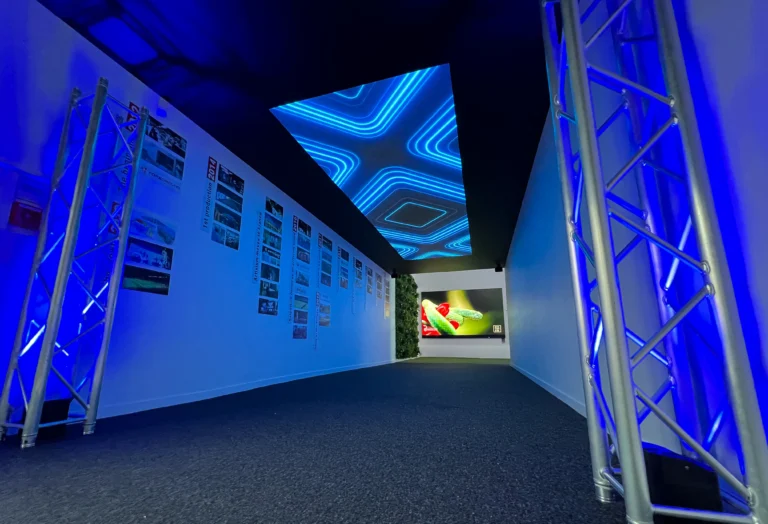
250 m² of screens running live, inside a 500 m² showroom: sport perimeter, fine-pitch indoor walls, outdoor DOOH at full brightness, rental panels rigged flat and curved, an LED floor, LED stairs, an LED ceiling and transparent screens. A dedicated training room hosts Novastar certification and operator sessions.
Can I compare pixel pitches side by side?
Yes. The screens and cabinets on permanent display span fine pitch to large-format outdoor, so you can stand in front of two of them and compare. Seeing the same content on two pixel pitches at your real viewing distance settles the specification faster than any datasheet.
Can I bring my own content to test?
Yes, and it is the most useful thing you can bring. Send us your files ahead of the visit or bring them on the day — seeing your own creative on the pitch and the brightness you are considering tells you more than a demo reel does.
How long does a visit take?
Anything from an hour to a full day. It depends on how much ground you want to cover: we take the time to talk through your project, and a meeting room is available to go into detail on the products and the installation.
Do I need to be a customer to visit?
No. The showroom is open to everyone. Book a slot through the form on this page or contact us — visits are by appointment so the demonstrations are set up for what you came to see.
LED Repair (7)
Will a repaired module still match the rest of the screen?
Repaired modules are tested for power, signal, colour and brightness before they go back. Where a serviced panel still reads differently from its neighbours, a calibration pass aligns it with the rest of the surface.
What does a maintenance contract cover?
Regular repair of Artixium products and selected third-party systems, over one year or several, with extension options up to five. After a contract expires, clients can still request repair or technical support on a case-by-case basis.
Is repair done on site or in the laboratory?
Both. Component-level work is carried out in our repair laboratory in Vaulx-en-Velin, France, under controlled workshop conditions. Where a fault can be resolved on the installation itself, technicians can travel to site instead of removing cabinets.
What can actually be repaired on an LED module?
LEDs, driver ICs, connectors, masks and damaged electronic components, as well as receiving cards and cabling. A module is only declared beyond repair once the diagnosis shows the fault is in the PCB itself, or the cost exceeds a replacement.
How does a repair start?
Through an RMA — a Return Merchandise Authorization. It records what is being returned and why, so reception, diagnosis, repair and return shipping are documented against the module rather than handled informally.
Can you ship replacement modules while mine are being repaired?
Spare-part shipments are coordinated with the repair workflow so an installation is not left degraded — see our logistics expertise.
Do you repair LED screens you did not manufacture?
Yes. Third-party LED products and modules are accepted for diagnosis and repair, provided the components are identifiable. Where the client can supply the references, the equipment can also be followed through a service record.
LED Training (8)
What happens after the training?
Teams can be supported through maintenance contracts, repair services or technical assistance. Training is often the first step of a longer support relationship rather than a one-off.
Who is the training for?
Technical teams who operate, install or maintain LED displays — integrators, rental crews, venue technicians and in-house AV teams. Content is adapted to the equipment in use and the level of the people being trained, from first handling to advanced integration.
Does the training cover calibration?
It covers calibration awareness — why brightness, colour and module consistency matter after installation or repair. The calibration work itself is carried out as a dedicated service.
Is a certificate issued?
Artixium can deliver a certificate confirming the skills reviewed during the session and the accreditation level reached by each participant.
How long is a session?
It depends on the modules selected and the level targeted. A programme is built from the equipment in use, the operational context and the responsibilities of the participants, then scoped accordingly rather than sold as a fixed package.
Where does the training take place?
On your site, around your own installation, or in an Artixium facility. On-site sessions have the advantage of using the exact system the team will be working on afterwards.
Which control software is covered?
Novastar and the other LED control tools used on the installed system: sending, checking and managing content, plus the configuration workflows a technician needs day to day.
Do you train on screens Artixium did not supply?
Yes. The programme is built around the equipment the team actually operates, whoever manufactured it.
LED Accessories (5)
Are these accessories compatible with Artixium LED displays?
Yes. The sending cards and processors we list work with Artixium panels and the wider LED ecosystem. Tell us your series and configuration and we’ll confirm the exact controller and receiving-card pairing.
Do you help with configuration and setup?
Yes. Artixium provides commissioning, screen mapping and on-site or remote configuration of the control chain, so your display is calibrated and running correctly from day one.
NovaStar or Colorlight — what’s the difference?
Both are industry-standard LED control brands. NovaStar is the most widely deployed ecosystem for fixed and rental installations; Colorlight is popular for high pixel-capacity, media-server workflows. We supply and support both, and recommend the one that best fits your content chain.
Which sending card do I need for my LED display?
The right sending card depends on your wall’s total pixel count and refresh rate. Small fixed installs run comfortably on a ~1.3M-pixel card (e.g. NovaStar MSD300), while large, media-server-driven walls need higher-capacity cards (NovaStar MSD600, Colorlight iT7). Artixium sizes the controller to each project.
What does a video processor do?
A video processor takes your source signals (HDMI, SDI, DisplayPort…), scales and switches them, and outputs a clean, correctly-mapped image to the LED wall. It handles seamless switching, scaling and multi-input layouts for live events, broadcast and control rooms.
Distribution (6)
Does Artixium manufacture its own LED displays?
Yes. Artixium is a French LED display manufacturer that designs and builds indoor, outdoor, rental and fixed LED screens, so distributors sell products engineered and supported by the same team — with the reliability and roadmap of a specialist brand behind them.
What kind of projects can I deliver as a distributor?
Artixium solutions cover sport, DOOH and media, events and rental and AV integration, across indoor and outdoor applications — from stadium perimeters and building façades to control rooms and retail. It gives you a broad range of LED display projects to pursue in your region.
How do I get started?
Use the form above to present your company, coverage area and priority markets. The Artixium team reviews each request and gets back to you to qualify the opportunity and propose the right partnership framework for your territory.
What support is included for distributors?
Every partnership can include complete onboarding and training on the products and how to specify an LED screen, ongoing technical support from the Artixium team, marketing materials, hands-on sales assistance and access to our quoting tool. You are never left to size or secure an installation on your own.
What tools do Artixium distributors get?
Distributors get Qmaker, our dedicated quoting tool for Artixium solutions, plus ready-made marketing content, brand assets and product documentation to present every project clearly. Combined with sales support, these tools cut admin time so you can focus on winning deals.
Who is the Artixium distributor programme for?
The programme is built for professionals who specify, sell, install or support LED display projects in their territory — AV integrators, resellers, rental companies and signage specialists. Whether you already work with LED walls or want to add them to your catalogue, the network gives you the pricing, tools and technical backing to compete.
Travel & Transportation (3)
What are the advantages of LED screens in the travel sector?
LED screens improve communication by broadcasting real-time information and advertising content.
Their high brightness ensures perfect visibility regardless of lighting conditions.
How do LED screens improve the overall traveler experience?
LED screens provide instant updates and attractive content, allowing travelers to stay informed and entertained throughout their journey.
Are LED screens suitable for outdoor use?
Yes, many LED screens are designed to withstand outdoor conditions.
They incorporate robust structures and specific protections that preserve them against the most demanding environments.
Commerce (3)
How do LED screens enhance customer engagement in retail?
LED screens capture attention through bright visuals and dynamic content, highlighting promotions or product information. They encourage customers to interact, which increases engagement and stimulates sales.
What is the durability of LED screens for in-store use?
LED screens are designed to last. Made from robust materials, they perfectly withstand the daily wear and tear of high-traffic retail environments, ensuring reliable performance and great longevity.
Can LED screens be customized for different commercial spaces?
Absolutely. Our LED cabinets, such as Qwartz and Thorite, are flexible and can be customized to suit various commercial environments, whether shopping centers or smaller boutiques.
Contact (3)
How quickly will you reply?
Within 24 working hours. An enquiry that arrives on Friday afternoon is handled on Monday morning. If your project has a deadline, put it in the message — that is what we prioritise on.
Can we come and see the screens?
Yes, by appointment. The Vaulx-en-Velin showroom runs the indoor, outdoor and rental ranges lit side by side, which is still the only honest way to compare a pixel pitch or a brightness figure.
Do you work outside France?
Yes. We ship and install worldwide, and the team behind that is international: alongside France, we have people in Canada, Portugal, Germany, Morocco and China.
No question matches your search.